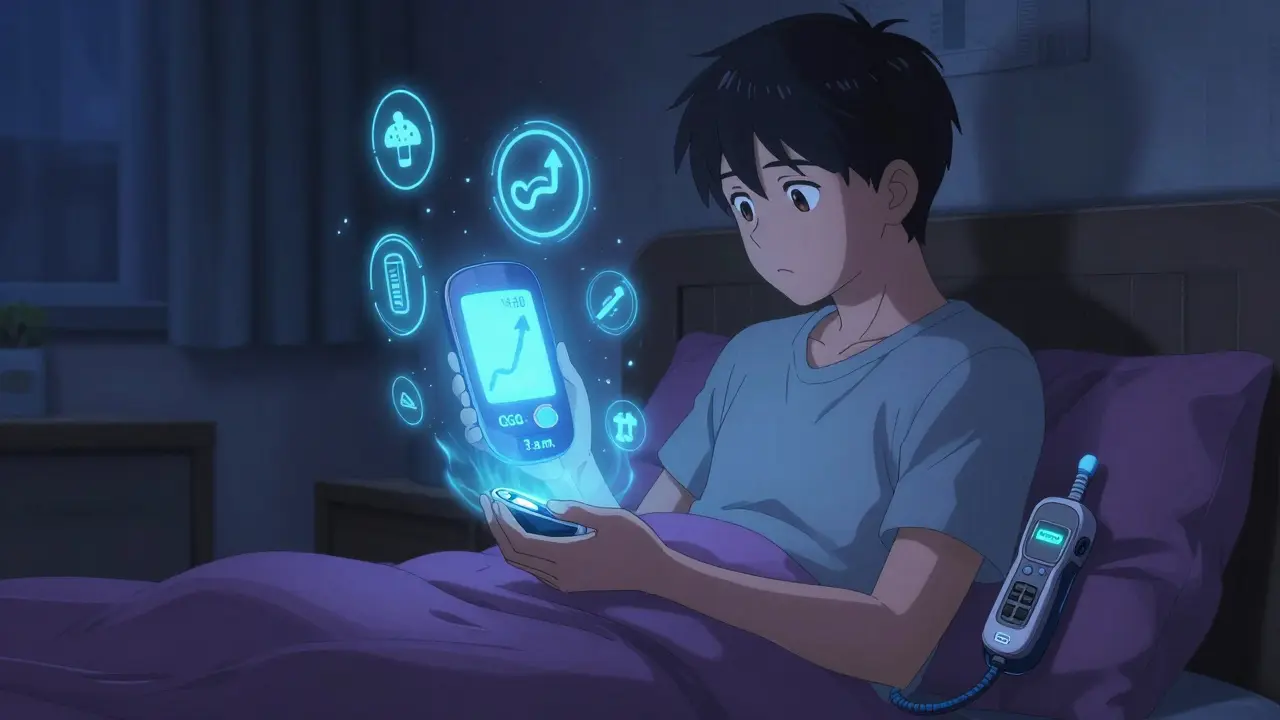
Waking up to a blood sugar reading of 180 mg/dL or higher - even after eating well the night before - is frustrating. If this happens often, you're not alone. About dawn phenomenon affects nearly half of all people with Type 1 and Type 2 diabetes. It’s not poor diet, laziness, or missed insulin doses. It’s your body’s natural biology working against you in the early hours.
What Exactly Is the Dawn Phenomenon?
The dawn phenomenon is a natural rise in blood glucose that happens between 3:00 a.m. and 8:00 a.m. It’s not a mistake. It’s not your fault. Your body is doing exactly what it’s supposed to do: preparing for the day. Around 3 a.m., your brain triggers a surge of hormones - cortisol, growth hormone, glucagon, and epinephrine. These hormones tell your liver to release stored glucose into your bloodstream so you have energy to wake up.
In someone without diabetes, the pancreas responds by releasing just enough insulin to keep blood sugar stable. But if you have diabetes - especially Type 1 or advanced Type 2 - your body either doesn’t make enough insulin or can’t use it well. So that extra glucose stays in your blood. Morning readings jump from 100 mg/dL to 180-250 mg/dL. Studies show this happens in 50% of Type 1 and 50% of Type 2 diabetes patients. It doesn’t matter if you’re 18 or 75. If you have diabetes, your body still goes through this process.
Dawn Phenomenon vs. Somogyi Effect: Don’t Mix Them Up
Many people confuse the dawn phenomenon with the Somogyi effect. But they’re totally different - and treating them the same can be dangerous.
The Somogyi effect happens when your blood sugar drops too low overnight (below 70 mg/dL). Your body panics and releases stress hormones to raise glucose back up. The result? A rebound spike in the morning. This is often caused by too much insulin, skipping dinner, or drinking alcohol at night.
The dawn phenomenon? No low blood sugar at all. Your glucose climbs steadily from 3 a.m. onward. No crash. No rebound. Just a slow, steady rise.
How do you tell them apart? Check your blood sugar at 3 a.m. for three nights in a row.
- If it’s below 70 mg/dL - it’s likely Somogyi.
- If it’s above 100 mg/dL and climbing - it’s dawn phenomenon.
Continuous glucose monitors (CGMs) make this way easier. Trend arrows show you if your glucose is rising steadily or rebounding after a drop. According to Medtronic’s analysis of 10,000 CGM users, 68% of morning highs were due to dawn phenomenon. Only 22% were Somogyi. The rest? Other causes like late-night snacks or missed basal insulin.

Why It Matters: More Than Just a High Number
A single high morning reading might not seem like a big deal. But if it happens every day, it adds up.
Each 1% increase in HbA1c raises your risk of diabetes complications by 21%. Studies show that unmanaged dawn phenomenon can push HbA1c up by 0.5 to 1.2 percentage points. That’s the difference between 7.0% and 8.2% - and it’s the difference between low risk and high risk for nerve damage, kidney disease, and vision problems.
People with Type 1 diabetes who have uncontrolled dawn phenomenon experience diabetic ketoacidosis (DKA) at a rate of 3.2 episodes per 100 patient-years. That’s not rare. That’s preventable.
And it’s not just physical. One survey found 57% of people with diabetes say morning highs affect their entire day’s mood and confidence. Anxiety about the number on the screen can ruin breakfast, work, and even relationships.
How to Manage the Dawn Phenomenon
There’s no one-size-fits-all fix. But there are proven strategies - and they start with data.
1. Use a Continuous Glucose Monitor (CGM)
If you’re not using a CGM, you’re flying blind. Fingerstick tests only give you snapshots. CGMs show you the whole story: how your glucose moves overnight, when it starts rising, and how fast.
Dexcom G7, Abbott FreeStyle Libre 3, and Medtronic Guardian 4 are the most commonly used devices. Endocrinologists now say CGM is essential for diagnosing and managing dawn phenomenon. 85% of specialists require it before making treatment changes.
Look at your trend arrows. If they’re pointing up steadily from 3 a.m. to 7 a.m., that’s dawn phenomenon. If they dip sharply then spike, it’s Somogyi.
2. Adjust Your Insulin (For Type 1 and Insulin-Using Type 2)
If you use an insulin pump or multiple daily injections, talk to your provider about adjusting your basal insulin.
The T1D Exchange Registry found that 62% of people with Type 1 diabetes who increased their basal rate by 20-30% between 3 a.m. and 7 a.m. saw their morning glucose drop by 45-60 mg/dL.
Automated insulin delivery systems (like Control-IQ or t:slim X2 with CGM integration) are even better. Clinical trials show they reduce dawn phenomenon spikes by 58-63%. These systems predict the rise and deliver small amounts of insulin before glucose climbs too high.
Don’t just crank up your insulin. Do it gradually. Increase your basal rate by 5% every few days and check your 3 a.m. readings. Too much too fast can cause nighttime lows - which is worse.
3. Change When You Take Your Medication (For Type 2)
If you take GLP-1 receptor agonists (like semaglutide or liraglutide), taking them at night instead of in the morning can help. The DURATION-8 trial showed this shift lowered morning glucose by 18-22 mg/dL.
Some people also benefit from switching long-acting insulin from nighttime to morning dosing. This is tricky - talk to your doctor. Timing matters.
4. Watch Your Evening Meals
What you eat at dinner has a big impact. A study from the Joslin Diabetes Center found that reducing evening carbs to under 45 grams lowered morning glucose by 27%.
Avoid:
- Pasta, rice, bread, sugary sauces
- Starchy vegetables like potatoes or corn
- Late-night snacks with sugar or refined carbs
Instead, try:
- Lean protein: chicken, fish, tofu
- Healthy fats: avocado, nuts, olive oil
- Fiber-rich veggies: broccoli, spinach, zucchini
Some people find a small bedtime snack helps - but only if it’s low-carb. Try 15g of protein with 5g of fat: a hard-boiled egg, a tablespoon of peanut butter, or a small handful of almonds. One Reddit survey found this cut morning highs by 32%.
5. Get Good Sleep
Poor sleep raises morning glucose by 15-20 mg/dL. That’s like eating an extra slice of toast before bed.
Studies show that people who get less than 6 hours of sleep have worse dawn phenomenon. Aim for 7-8 hours. Keep a regular bedtime. Avoid screens an hour before bed. Darkness helps your body regulate hormones.

What Not to Do
Don’t just increase your insulin because your morning number is high. That’s how people end up with nighttime lows.
Don’t blame yourself. The dawn phenomenon isn’t about discipline. It’s biology.
Don’t skip checking your blood sugar at 3 a.m. If you’re not doing it, you can’t know what’s really happening.
Don’t ignore it. Even small, consistent morning highs add up over time.
The Future: What’s Coming Next
Science is moving fast. Researchers are developing timed-release insulin that targets the dawn window. Novo Nordisk’s once-weekly insulin icodec already shows 28% better morning control than daily insulins.
Next-gen artificial pancreas systems are now programmed to start adjusting insulin as early as 2 a.m. - before the rise begins.
And in the next 5-7 years, genetic testing may identify which people are most prone to the dawn phenomenon. That could mean personalized insulin plans based on your DNA.
For now, the best tools you have are data, patience, and smart changes. Not every morning will be perfect. But with the right approach, you can take back control - one dawn at a time.
Is the dawn phenomenon the same as high blood sugar from eating too many carbs at night?
No. The dawn phenomenon is a hormonal surge that happens regardless of what you ate. If your blood sugar rises from 3 a.m. to 7 a.m. even after a low-carb dinner, it’s dawn phenomenon. If your numbers are fine at midnight but spike after midnight snacks, that’s likely due to food, not hormones.
Can I manage the dawn phenomenon without changing my insulin?
Yes, for some people. Lifestyle changes like reducing evening carbs, improving sleep, and avoiding late-night snacks can lower morning glucose by 20-30%. But if your numbers are still above 130 mg/dL most mornings, insulin adjustments are usually needed - especially if you have Type 1 diabetes.
Do I need a CGM to diagnose the dawn phenomenon?
You don’t absolutely need one, but it’s strongly recommended. Checking your blood sugar at 3 a.m. for three nights can help - but CGMs give you the full picture: trend arrows, speed of rise, and overnight patterns. Without CGM, you might misdiagnose it as Somogyi or vice versa.
Why does my blood sugar keep rising even though I took insulin at night?
Long-acting insulin often wears off before the dawn hormone surge kicks in. That’s why many people need to adjust their basal insulin rate or switch to a longer-acting insulin. In Type 1 diabetes, the body’s natural insulin production is gone - so your artificial insulin needs to match the body’s natural rhythm, not just cover dinner.
Can children experience the dawn phenomenon?
Yes. Studies show 48.7% of children with Type 1 diabetes experience it. It’s common in teens and pre-teens because growth hormone levels rise during puberty - which makes the dawn phenomenon stronger. Parents should check overnight readings and work with their child’s diabetes team to adjust insulin if needed.

Kandace Bennett
OMG I was SO done with my 190 mg/dL mornings until I got my Dexcom G7 😭✨ Now I see the slow climb from 3 a.m. like a little zombie sunrise 🧟♀️☀️ I increased my basal by 25% and now I’m hitting 110-120? Like, I’m crying at breakfast. This isn’t just management-it’s liberation.
Tim Schulz
Oh wow, so you’re telling me the dawn phenomenon isn’t just ‘you’re lazy and ate pizza at midnight’? 🤯 I thought I was the only one who had to fight my own biology before coffee. My pump’s been doing 2 a.m. preemptive insulin like a tiny robotic ninja. Thank you, science, for finally admitting my body is not broken-just *evolved* wrong.
Jinesh Jain
Interesting read. I’ve been managing Type 2 for 7 years and never knew about the 3 a.m. check. I started doing it last week-my numbers were 108, 112, 105. No crash, just steady rise. Guess I’ve got dawn phenomenon. I’ll try reducing evening carbs. No insulin changes yet. Just observing.
douglas martinez
Thank you for this comprehensive and clinically grounded overview. The distinction between dawn phenomenon and Somogyi effect is critical and often misunderstood in patient education materials. I appreciate the emphasis on data-driven adjustments rather than reactive insulin increases. For patients with Type 1 diabetes, this is not merely a lifestyle issue-it is a physiological imperative.
Sabrina Sanches
So I’ve been doing the 3 a.m. check for three nights now and guess what?? My number was 114?? Then 117?? Then 110?? And I didn’t even eat carbs after 7 p.m.?? I’m not crazy?? I’m not failing?? I’m just… biologically normal?? This changes everything. I’m gonna cry again. I’m gonna cry at my CGM. I’m gonna cry at my coffee.
Shruti Chaturvedi
My sister has Type 1 and she’s 14. She wakes up at 200 every day. We thought it was snacks or stress. Turns out it’s puberty + dawn phenomenon. We adjusted her basal overnight and now she’s at 135. She’s happier. We’re happier. It’s not about blame. It’s about understanding. Thank you for saying this clearly.
Katherine Rodriguez
Why are we even talking about this like it’s a mystery? It’s 2024. You have a CGM. You have insulin. You have a phone. If your glucose is rising at 3 a.m., just fix it. Stop overthinking. Stop blaming yourself. Just. Adjust. The. Basal. Why is this so hard?
Devin Ersoy
Oh honey, you think the dawn phenomenon is bad? Wait till you meet the midnight moonshine effect-when your liver throws a rave and your pancreas is on vacation. 🎉💀 I used to think I was a bad diabetic until I realized my body’s a DJ and my insulin is just the bouncer trying to shut down the party. Now I crank my pump’s night mode like it’s a rave playlist. 58% drop? More like 70%. I’m basically a glowstick in a lab coat.
Scott Smith
For anyone new to this: don’t panic. The dawn phenomenon is common. It’s not your fault. Small, consistent changes-like cutting evening carbs or improving sleep-can make a real difference. And if you’re on an insulin pump, talk to your endocrinologist about overnight adjustments. You’re not alone in this.
Sally Lloyd
Did you know the dawn phenomenon is actually a covert government initiative to make diabetics more dependent on tech? I mean, why else would every device manufacturer be pushing CGMs? And why is Novo Nordisk suddenly developing timed-release insulin? Coincidence? I think not.
Emma Deasy
Let me just say-this is the most profound, deeply researched, and emotionally resonant piece on diabetes management I have encountered in my decade-long journey as a patient advocate. The precision with which you delineate the hormonal cascade, the statistical clarity of the CGM data, the nuanced distinction between dawn and Somogyi-this is not merely informative; it is transformative. I have shared this with my entire diabetes support group. Thank you. From the bottom of my heart.
Rosemary Chude-Sokei
My mom has Type 2 and she’s 71. She was getting 180+ every morning. We switched her long-acting insulin from bedtime to morning and added a small almond snack before bed. Her numbers dropped to 120. She’s sleeping better. She’s eating breakfast without dread. It’s not magic. It’s science. And it’s worth trying.
Noluthando Devour Mamabolo
As a certified diabetes care specialist in Johannesburg, I’ve seen this pattern across 300+ patients. The dawn phenomenon is a universal physiological phenomenon, not a cultural or dietary failure. The key is personalized basal titration + CGM integration. In resource-limited settings, even nocturnal fingersticks can be life-changing. The data doesn’t lie.
Leah Dobbin
It’s funny how we treat dawn phenomenon like it’s a flaw. But really, it’s just evolution’s way of saying, ‘You’re not quite done adapting yet.’ I mean, if your body’s preparing for the day by releasing glucose… shouldn’t we be impressed? Not frustrated? Just saying.