Key Takeaways
- Targeted Therapies: Use drugs to block specific proteins that help cancer cells grow; often taken as a daily pill.
- Cellular Therapies: Reprogram your T-cells to recognize and kill cancer, offering hope for relapsed or refractory cases.
- Improved Outcomes: New treatments have significantly delayed complications like Richter transformation in CLL patients.
- Trade-offs: While more effective, these therapies come with unique side effects (like CRS) and high financial costs.
How Targeted Therapies Change the Game
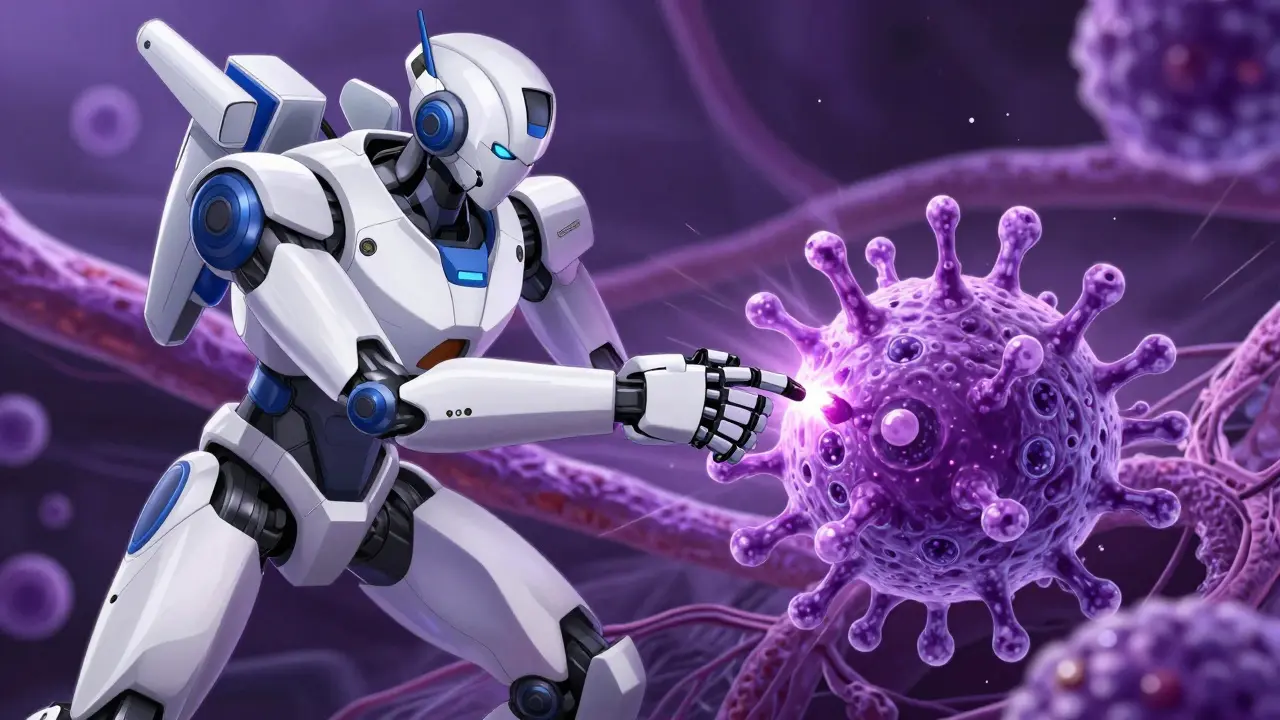
Unlike chemo, which attacks all dividing cells, targeted therapies act like a guided missile. They identify a specific "glitch" in the cancer cell's DNA or a protein on its surface and shut it down. This approach usually means fewer systemic side effects, though it isn't without its own challenges. One of the biggest success stories is the use of BTK Inhibitors. These drugs block Bruton tyrosine kinase, a signaling molecule that B-cells need to survive. Drugs like ibrutinib and acalabrutinib are now standard for many patients with chronic lymphocytic leukemia (CLL). Instead of spending weeks in a clinic for infusions, patients take a pill daily. Then there are BCL-2 Inhibitors, such as venetoclax. This drug targets the BCL-2 protein, which basically acts as a "survival switch" for cancer cells. By flipping that switch off, the cancer cell is forced to undergo apoptosis, or programmed cell death. However, these aren't simple medications to start; they require a careful "ramp-up" period over five weeks to prevent tumor lysis syndrome, a dangerous condition where too many cancer cells die at once and flood the bloodstream with toxins.The Power of Cellular Therapy and CAR T-Cells
While targeted therapies use chemicals to block pathways, cellular therapy uses biology. The most famous version of this is CAR T-cell therapy. Here is how the process actually works in a real-world clinical setting:- Leukapheresis: Your blood is drawn, and T-cells (your immune soldiers) are collected and separated from the rest of the blood.
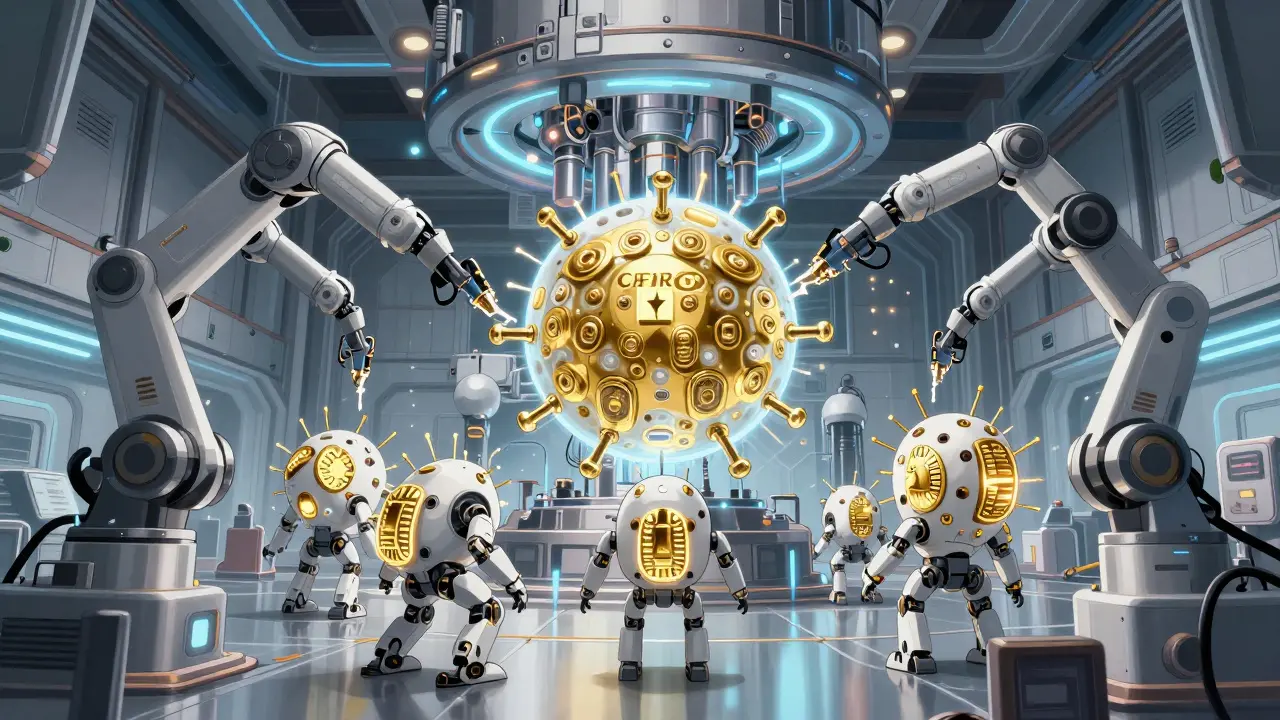
- Genetic Engineering: In a lab, scientists add a "chimeric antigen receptor" (CAR) to these cells. This receptor allows the T-cell to recognize a specific protein, like CD19, on the surface of the lymphoma or leukemia cell.
- Expansion: The modified cells are grown in massive quantities over several weeks.
- Reinfusion: The "super-charged" cells are infused back into your body to hunt down the cancer.
Comparing the Two Approaches
Choosing between a targeted drug and a cellular therapy usually depends on the stage of the disease and how the patient has responded to previous treatments.| Feature | Targeted Therapy (e.g., BTK/BCL-2) | Cellular Therapy (e.g., CAR T) |
|---|---|---|
| Administration | Mostly oral (pills) | Complex multi-step infusion process |
| Treatment Duration | Often continuous/long-term | Typically a single infusion |
| Primary Goal | Disease control/Slow progression | Deep remission/Potential cure |
| Common Risks | Drug resistance, long-term toxicity | Cytokine Release Syndrome (CRS), Neurotoxicity |
| Approx. Cost | High monthly cost ($15k - $25k) | Extremely high one-time cost ($373k - $475k) |
The Reality of Side Effects and Management
These treatments aren't "magic bullets" without consequences. Because cellular therapies activate the immune system so aggressively, patients often experience Cytokine Release Syndrome (CRS). This is essentially a massive inflammatory response that can cause high fevers and dangerously low blood pressure. This is why CAR T-cell therapy requires certified centers with ICU capabilities; you can't just do this at a small community clinic. Neurotoxicity is another concern, affecting 20% to 40% of CAR T patients. It can manifest as confusion, tremors, or difficulty speaking. While usually reversible, it requires specialized monitoring. On the other hand, targeted therapy patients face a different battle: resistance. Over time, the cancer often mutates, and the drug stops working. For those with specific mutations like del(17p) or TP53, this window of effectiveness is often much shorter.Navigating the Costs and Access
We have to talk about the elephant in the room: the price. With CAR T-cell courses costing up to $475,000, there is a massive gap in who can access these treatments. While 89% of NCI-designated cancer centers offer these services, only about 32% of community practices do. This creates a geography-based lottery for survival. Even for targeted therapies, the financial toxicity is real. Paying $15,000 to $25,000 out-of-pocket per month is unsustainable for most families. Many patients now rely on manufacturer-sponsored nurse navigators and pharmaceutical assistance programs to keep their treatment on track. The ethical dilemma for doctors in 2026 is no longer just "will this work?" but "can this patient actually afford the cure?"
What's Next for Hematologic Cancer Care?
The future is moving toward using these powerful tools earlier in the diagnosis. In the past, CAR T was a "last resort" for patients who had failed everything else. However, experts predict that by 2030, high-risk lymphomas will be treated with cellular therapies as a first-line defense. We are also seeing a shift toward "off-the-shelf" (allogeneic) therapies that wouldn't require the 3-5 week manufacturing wait time. Imagine a world where a doctor can prescribe a CAR T-cell infusion as easily as an antibiotic, without waiting for a lab to engineer your own cells. Until then, the combination of targeted agents-like using venetoclax and obinutuzumab together-is providing deep, durable remissions that allow people to live decades longer than they would have with traditional chemo.What is the difference between a targeted therapy and a cellular therapy?
Targeted therapies are chemical drugs (often pills) that block specific proteins or molecular pathways that cancer cells use to grow. Cellular therapies, like CAR T-cell therapy, are biological treatments where a patient's own immune cells are genetically reprogrammed in a lab to recognize and kill cancer cells before being put back into the body.
Can CAR T-cell therapy actually cure leukemia or lymphoma?
While "cure" is a strong word in oncology, CAR T-cell therapy has provided complete remissions in patients who were previously considered untreatable. For example, some patients with relapsed mantle cell lymphoma have seen total disappearance of disease, though long-term survival rates vary by specific cancer subtype.
How long does the CAR T-cell process take from start to finish?
The manufacturing process typically takes 3 to 5 weeks. This is the time required to collect your T-cells via leukapheresis, genetically modify them to express the CAR receptor, and grow enough cells to create a therapeutic dose.
What are the most common side effects of BTK inhibitors?
Common side effects include atrial fibrillation, hypertension, and bruising. Because these drugs are often taken daily over many years, doctors monitor for long-term toxicity and the development of drug resistance, where the cancer evolves to bypass the blocked pathway.
Why are these treatments so expensive?
The cost stems from the extreme complexity of the manufacturing. Each CAR T-cell dose is a personalized medicine created specifically for one individual. It requires sterile lab environments, genetic engineering, and highly specialized staff to ensure the cells are safe and effective.
Next Steps for Patients and Caregivers
If you are exploring these options, your first step should be requesting a molecular profile or genomic sequencing of the tumor. You can't use a targeted therapy if you don't know which "target" the cancer has. Ask your oncologist specifically about:- Whether the cancer expresses CD19 or CD20 (critical for CAR T eligibility).
- The status of the TP53 mutation or del(17p) deletion.
- Whether a fixed-duration therapy (like venetoclax combinations) is an option to avoid long-term drug dependency.

Kim Hyunsoo
The idea of reprogramming T-cells is just absolutely mind-bending... feels like some sort of sci-fi neon future brought to life in a sterile lab (o_o)
william wang
It's really important to emphasize the molecular profiling part. I've seen a few cases where patients didn't get the specific genomic sequencing early enough and missed a window for a targeted therapy that would have been much gentler than standard chemo.
Jon lee
That's a great point about the sequencing. For anyone feeling overwhelmed, just remember that you can always ask for a second opinion at a major academic center if your local clinic isn't offering these advanced genomic tests.
Tama Weinman
Sure, the science is "pretty" on paper, but let's be real about who actually benefits here. It's just another way for big pharma to lock the door and charge a premium for a "cure" that they've carefully metered out so the profit margins stay astronomical while we're told it's a "geography-based lottery" as if that's just an unfortunate accident of nature and not a calculated business model to keep the poor in the dark.
Agatha Deo
Oh please, calling this "precision care" is such a cute euphemism. It's basically just a high-stakes gambling ring where the house always wins, and the only "precision" involved is how accurately they can drain your bank account before you hit a cytokine storm and end up in the ICU anyway. 🙄
Cheryl C
USA medical tech is just way better than anythin else!!! 🇺🇸🇺🇸 CAR T is a miracle and we're leadin the way baby!! hope everyone gets access soon 🇺🇸💪🔥
Rob Schlautman
i mean honestly who cares about the cost when the manufacturing wait time is like a whole month and you're just sitting there praying the cancer doesnt mutate into something else while some technician in a lab is playing with your cells in a petri dish which is just a complete joke if you actually think about the logistics of the whole thing
Richard Moore
I completely agree that the accessibility gap is a major issue! 😡 We need to push for better policy changes so these life-saving treatments aren't just for the wealthy few! 🏥✨
Nell O'Leary
The pharmacological profile of BCL-2 inhibitors is fascinating, especially regarding the apoptotic pathway activation 🧬. The ramp-up period is a critical pharmacokinetic necessity to avoid TLS (tumor lysis syndrome) which would be catastrophic for the renal system! (^_^)v
Dana Chichirita Nicoleta
It is truly a breathtaking miracle of modern science that we can now look at the very building blocks of a human being and decide exactly which part needs to be fixed to save a life! I am absolutely overwhelmed with joy thinking about the thousands of families who will get more time, more hugs, and more memories because of these cellular breakthroughs, and it gives me such an incredible sense of hope for every single person fighting this battle right now!
Nathan Berlin
imagining people think these costs are high in the west while my country's brilliance is ignored 🙄😂 we would do it better and cheaper anyway 🇮🇳🇮🇳