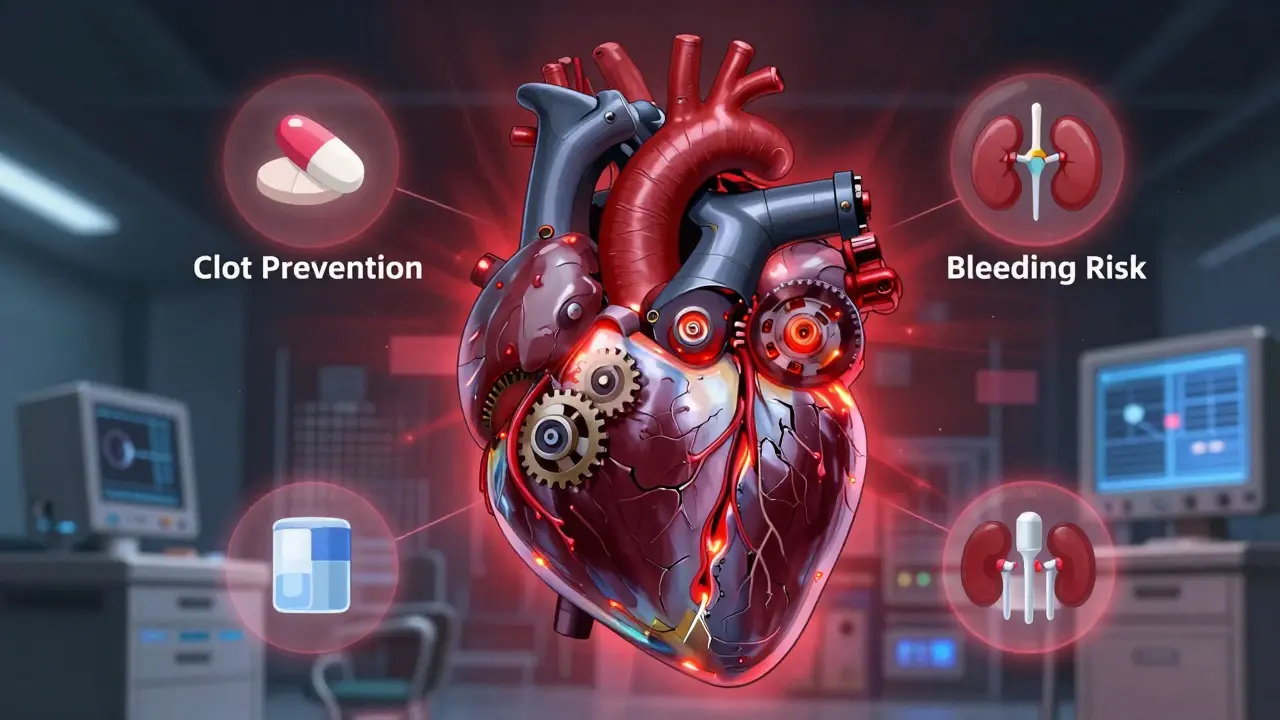
DOAC Dosing Calculator
Determine Your Appropriate DOAC Dose
Based on current guidelines for apixaban, rivaroxaban, and dabigatran. Always consult your healthcare provider before making dosage changes.
Your Recommended Dose
When you take a blood thinner, you're not just preventing a clot-you're walking a tightrope between two dangers: thrombosis and hemorrhage. For millions of people with atrial fibrillation, deep vein thrombosis, or mechanical heart valves, anticoagulants are lifesavers. But every pill carries a hidden cost: the risk of uncontrolled bleeding. And that risk doesn’t go away with time-it changes, grows, and sometimes sneaks up when you least expect it.
Why Blood Thinners Are a Double-Edged Sword
Anticoagulants don’t actually "thin" your blood. They interrupt the clotting process. That’s why they work so well for preventing strokes in atrial fibrillation or stopping clots after surgery. But if something goes wrong-a fall, a cut, an ulcer-and your body can’t form a clot, bleeding can become life-threatening. The most common anticoagulants today fall into three groups: warfarin, DOACs (direct oral anticoagulants), and heparins. Each has its own risks, benefits, and quirks. Warfarin, the old-school option, has been around since the 1950s. It’s cheap-about $4 a month-but demands constant monitoring. Your INR (International Normalized Ratio) must stay between 2.0 and 3.0 for most people. Go above 4.0? Your bleeding risk jumps sharply. Stay below 1.5? You’re not protected from clots. DOACs like apixaban, rivaroxaban, and dabigatran changed the game. No weekly blood tests. Fixed doses. Fewer food interactions. But they come with their own traps. If your kidneys aren’t working right, these drugs can build up in your system. And unlike warfarin, you can’t just check your levels with a simple finger-prick test.The Real Culprits Behind Major Bleeding Events
Most people think bleeding happens because of the drug itself. But in reality, it’s usually a mix of factors. Studies show that 80% of major bleeding events in patients on anticoagulants involve at least one avoidable cause:- Dual therapy-taking both an anticoagulant and an antiplatelet like aspirin or clopidogrel. This combination can double your bleeding risk.
- Dosing errors-especially in older adults. A 5 mg dose of rivaroxaban might be fine for a 70-year-old with normal kidneys, but deadly for someone with CrCl below 30 mL/min.
- Renal impairment-if your kidneys are struggling, DOACs stick around longer. Apixaban requires dose reduction at CrCl <25 mL/min. Rivaroxaban at <50 mL/min. Miss that? You’re asking for trouble.
- Concurrent NSAIDs-ibuprofen, naproxen, even occasional Advil. These irritate the stomach lining and make bleeding from ulcers more likely.
- Poor adherence-skipping doses or stopping cold turkey increases clot risk, but so does taking double doses out of fear.
DOACs vs. Warfarin: Which Is Safer?
It’s not a simple "better or worse" question. DOACs have a 19-20% lower risk of major bleeding than warfarin overall, according to pooled data from clinical trials. Apixaban stands out-it cut major bleeding by 31% compared to warfarin in the ARISTOTLE trial. But here’s the catch: DOACs aren’t always the right choice.- If you have a mechanical heart valve, especially a mitral valve, DOACs are dangerous. They increase clotting risk here. Warfarin is still the gold standard.
- If you have antiphospholipid syndrome, warfarin is strongly preferred. DOACs have failed in trials here.
- If you’re on dialysis or have severe kidney failure, most DOACs aren’t approved. Heparin or warfarin are safer bets.
What to Do When Bleeding Happens
If someone on anticoagulants starts bleeding heavily-vomiting blood, passing black stools, or having a sudden headache-time is everything. You don’t wait for a doctor. You act. For warfarin: The fastest fix is four-factor prothrombin complex concentrate (4f-PCC). It reverses INR in under 15 minutes. Fresh frozen plasma? Takes 30 minutes to thaw, and you need 15-30 mL per kg. Too slow for emergencies. For dabigatran (a direct thrombin inhibitor): Idarucizumab is the antidote. It’s specific. It works fast. Given as two 2.5g IV doses. But it’s expensive and not always in stock. For apixaban, rivaroxaban, edoxaban (factor Xa inhibitors): Andexanet alfa is approved. But it costs about $13,000 per dose. Many hospitals don’t keep it on hand. In those cases, activated charcoal (if taken within 2 hours) and supportive care are the best options. For heparin: Protamine sulfate reverses unfractionated heparin. It’s only partially effective against low molecular weight heparins like enoxaparin. That’s why many hospitals avoid LMWH in high-risk patients.
Prevention Starts Before You Even Take the First Pill
The best way to prevent hemorrhage? Don’t start anticoagulation unless you really need it. And if you do start, manage it like a precision instrument.- Assess kidney function at baseline and every 3-6 months. More often if you’re over 75 or have diabetes.
- Review all medications. Cut out NSAIDs. Avoid combining anticoagulants with SSRIs or antiplatelets unless absolutely necessary.
- Check for bleeding signs. Unexplained bruising, gum bleeding, nosebleeds that won’t stop-these aren’t normal. They’re warning signs.
- Use risk scores. CHA₂DS₂-VASc for stroke risk in atrial fibrillation. HAS-BLED for bleeding risk. If HAS-BLED is 3 or higher, you need a plan-not just a prescription.
- Know your reversal agents. If you’re on a DOAC, ask your doctor: "What’s the plan if I bleed?" If they say "call 911," that’s not good enough.
The Future: Better Tools, Fewer Bleeds
The next big leap isn’t a new drug-it’s better monitoring. Right now, we have no quick way to check DOAC levels like we do with INR for warfarin. But new point-of-care tests are in development. Early models suggest they could reduce bleeding events by 15-20% by catching high drug levels before they cause harm. A universal reversal agent called ciraparantag is in late-stage trials. If it works, it could reverse all anticoagulants with one shot. No more guessing which antidote to use. Just give it and wait. For now, the message is clear: anticoagulants save lives, but they demand respect. They’re not just pills. They’re tools that require ongoing attention, clear communication, and smart decisions.Every patient on anticoagulation should have a bleeding action plan. Not a vague "call your doctor" instruction. A specific, written guide: "If I have this symptom, do this. If I fall, call this number. If I miss a dose, here’s what to do."
Because when the line between clotting and bleeding is this thin, preparation isn’t optional-it’s survival.
Can you reverse anticoagulants at home?
No. Reversal agents like 4f-PCC, idarucizumab, and andexanet alfa require intravenous administration and medical supervision. These are not available outside hospitals or emergency centers. If you suspect serious bleeding, call emergency services immediately. Do not try to manage it at home with over-the-counter remedies.
Which anticoagulant has the lowest bleeding risk?
Apixaban has the lowest risk of major bleeding among all approved anticoagulants. In the ARISTOTLE trial, it reduced major bleeding by 31% compared to warfarin. It’s also less dependent on kidney function than rivaroxaban or dabigatran, making it safer for older adults and those with mild kidney impairment.
Is warfarin still used today?
Yes, but only for specific cases. Warfarin remains the first choice for patients with mechanical heart valves (especially mitral valves) and those with antiphospholipid syndrome. DOACs are not approved or effective for these conditions. For most other patients-like those with atrial fibrillation-DOACs are now preferred due to lower bleeding risk and no need for regular blood tests.
How often should kidney function be checked on DOACs?
Kidney function (CrCl) should be checked at the start of treatment and every 3 to 6 months if you’re stable. If you’re over 75, have diabetes, or have known kidney disease, check it every 3 months. A drop in CrCl below 30 mL/min may require switching to warfarin or stopping the DOAC entirely.
Can you drink alcohol while on anticoagulants?
Moderate alcohol (one drink per day) is usually okay, but heavy or binge drinking is dangerous. Alcohol can interfere with how warfarin is processed by the liver, causing INR to spike unpredictably. With DOACs, alcohol doesn’t interact directly, but it increases fall risk and can irritate the stomach lining-both raise bleeding risk. Avoid heavy drinking entirely.
What if I need surgery or a dental procedure?
Never stop anticoagulants on your own. For minor procedures like tooth extractions, most DOACs can be held for 24-48 hours before and resumed 24 hours after, with no increased bleeding risk. For major surgery, your doctor will use risk scores to decide whether to stop, bridge with heparin, or proceed without interruption. Always consult your prescribing provider at least 1 week before any procedure.

Chris Bird
Been on warfarin for 5 years. INR at 4.2 last week because I ate a whole bag of kale. Docs said "just reduce your dose" like it's a snack. Bleeding out is real. I had a nosebleed that lasted 3 hours. No joke. Don't play with this stuff.
Also, DOACs aren't magic. My cousin died from a brain bleed on rivaroxaban. Kidney function was low. No one checked. RIP.
Donnie DeMarco
Y’all act like blood thinners are some kind of superhero pill. Nah fam. It’s more like juggling chainsaws while riding a unicycle on a tightrope made of wet noodles.
DOACs? Cool. But if your kidneys are moonwalking, you’re just storing a time bomb in your bloodstream. And don’t get me started on people popping aspirin like M&Ms because "it’s just a baby aspirin." Bro, that’s not a baby. That’s a grenade with a pull tab.
Shourya Tanay
The pharmacokinetic variability of DOACs in patients with stage 3 CKD is profoundly underappreciated in primary care settings. Apixaban’s renal clearance drops precipitously below a CrCl of 25 mL/min, yet many clinicians continue prescribing standard dosing without recalibrating for eGFR decline. This isn't just negligence-it's systemic underestimation of non-linear drug metabolism in aging populations.
Furthermore, the absence of reliable point-of-care monitoring for DOACs creates a dangerous therapeutic blind spot. Unlike warfarin’s INR, which offers real-time feedback, DOACs require clinical inference-often too late.
LiV Beau
So true!! 😭 I’m a nurse and I’ve seen so many older patients on 20mg of rivaroxaban even though their kidneys are barely working. We’re not talking about a little tweak here-we’re talking about life or death.
And don’t even get me started on the combo of anticoagulant + NSAID + aspirin. It’s like throwing gasoline on a campfire and saying "I’m just trying to feel better."
Also, if you’re on these meds, PLEASE tell your dentist. I had a patient bleed out during a tooth extraction. No one knew she was on dabigatran. 😣
Adam Kleinberg
They say anticoagulants save lives but the real story is this: pharmaceutical companies made billions by replacing a cheap, monitorable drug with 4 expensive ones that can’t be reversed easily
And now they tell you to trust them? No thanks. I’ve seen too many obituaries with "on DOACs" in the obituary. It’s not medicine-it’s corporate convenience disguised as innovation
Warfarin worked for 70 years. Why fix what ain’t broke? Because they can charge $300 a pill now
Denise Jordan
So let me get this straight-you take a pill that makes you bleed easier so you don’t get a clot that might kill you? Sounds like a gamble I didn’t sign up for.
I’d rather just not move and hope I don’t get a stroke.
Gene Forte
Every medical decision carries weight. Anticoagulation is not merely pharmacological-it is existential. The choice to take these medications is not taken lightly. It is a commitment to a life of vigilance, of routine, of quiet courage.
For many, this is not about convenience. It is about dignity. The dignity to walk, to breathe, to live without the shadow of a clot stealing their future.
Let us not reduce this to a cost-benefit spreadsheet. This is human life, measured in INRs and CrCls, but lived in moments.
Kenneth Zieden-Weber
Oh wow. So you’re telling me that a drug that prevents clots can also make you bleed out if you sneeze too hard? And we call this "medicine"?
Let me guess-the instructions say "take once daily" and don’t mention "avoid stairs," "don’t hug your dog," or "don’t be human."
Also, why is there no pill that says "I’ll stop clotting but I’ll also stop bleeding"? That’s the dream, folks. That’s the holy grail. Not this half-baked tightrope walk.
David L. Thomas
One thing no one talks about: the mental toll. You start checking every bruise. You panic when you cut your finger. You avoid roller coasters, sex, yoga, even sneezing.
It’s not just the physical risk-it’s the constant low-grade anxiety. I’m 42. I used to run marathons. Now I walk like I’m in a minefield.
And yeah, I know DOACs are "better." But better doesn’t mean safe. It just means less paperwork.
Bridgette Pulliam
As someone who has managed anticoagulation therapy for over a decade, I must emphasize the importance of multidisciplinary care. Pharmacists, nurses, and patient educators are not ancillary-they are frontline guardians in preventing hemorrhagic events.
Furthermore, patient autonomy must be respected. The decision to initiate or continue anticoagulation is not a clinical algorithm-it is a deeply personal, value-laden choice.
And yes, I have seen patients refuse therapy because they feared bleeding more than stroke. Their fear is valid. Their choice deserves reverence.
Mike Winter
It’s fascinating how we’ve normalized the idea that life-saving treatment should come with a built-in death sentence. We accept that a drug can prevent a stroke but make a minor fall potentially fatal. That’s not progress. That’s a trade-off we’ve been sold without full disclosure.
And yet-we still don’t have a reliable reversal agent for most DOACs. Why? Because the market doesn’t incentivize it. Profit > patient safety. Again.
Randall Walker
My uncle died from a GI bleed on apixaban. He was 78. Kidney function was 38. They didn’t reduce the dose. They didn’t even check. Just "prescribed as per guidelines."
Guidelines are written for populations. People aren’t populations.
And now I have to watch my mom take it. And I’m terrified.
Miranda Varn-Harper
It is imperative to acknowledge that the current paradigm of anticoagulant management reflects a systemic failure of risk stratification. The conflation of clinical convenience with therapeutic efficacy is not merely a flaw-it is a moral hazard.
Furthermore, the widespread adoption of DOACs without robust, long-term, real-world data constitutes an uncontrolled clinical trial on the aging population. This is not evidence-based medicine. This is pharmacological experimentation.
Alexander Erb
Hey everyone, just wanted to say-I’m on apixaban and I’m still alive! 😊
My doc adjusted my dose after my kidney test. I take it with food. I don’t take ibuprofen. I wear non-slip socks. And I tell every new doctor I see.
It’s not perfect, but it works. You can do this. Stay smart. Stay safe. You got this 💪❤️
Tom Bolt
They say "don’t stop your blood thinner"-but what if the real danger isn’t the clot… but the drug itself?
What if the entire system is built on fear? What if the bleeding risk is being downplayed so they can keep selling pills?
I’m not saying don’t take them. I’m saying question everything. Always.