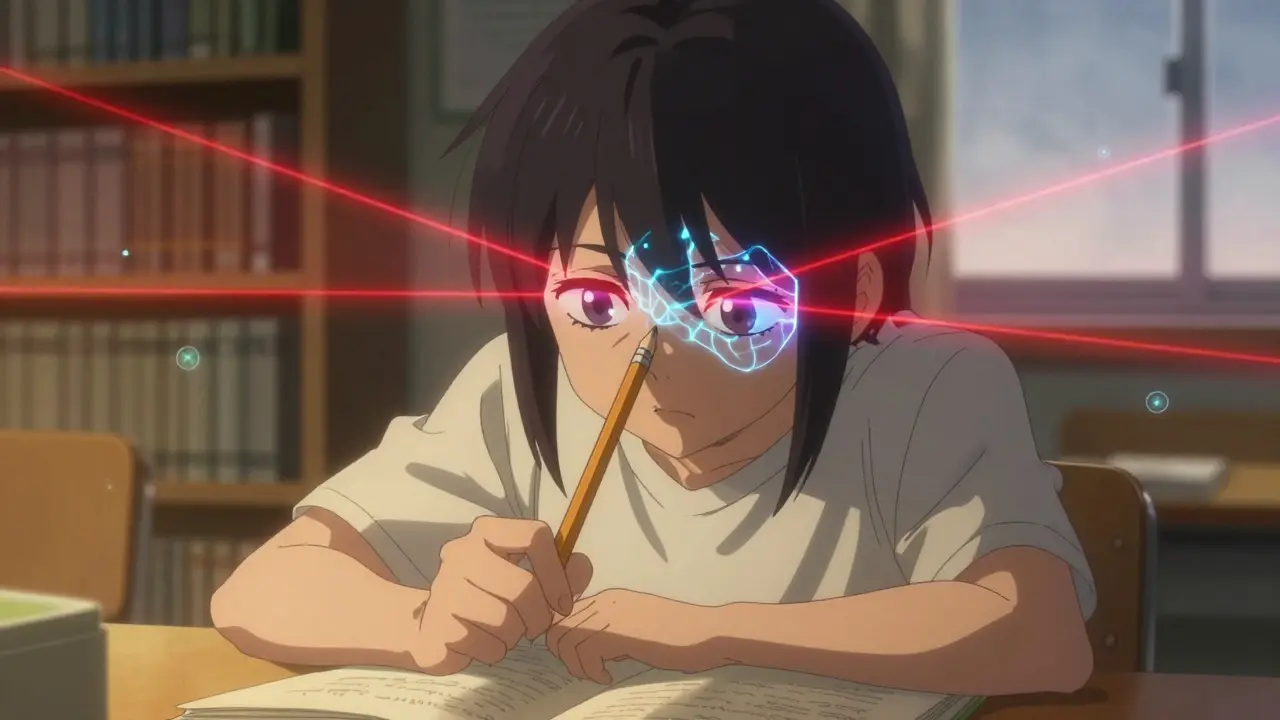
When reading a book, staring at a screen, or doing homework, most people don’t think about how their eyes work together. But for about 1 in 10 people-especially kids and young adults-this simple task can feel exhausting. Eyes that won’t turn inward properly cause convergence insufficiency, a hidden vision problem that leads to headaches, blurred vision, double images, and trouble focusing on close work. It’s not laziness. It’s not poor eyesight. It’s a specific neurological issue with how the eyes coordinate. And the good news? It’s one of the most treatable binocular vision disorders out there.
What Exactly Is Convergence Insufficiency?
Convergence insufficiency (CI) happens when your eyes struggle to turn inward to focus on something nearby-like a phone, a book, or a computer screen. Normally, your eyes naturally converge as an object gets closer. In CI, they drift outward instead. This misalignment forces your brain to work overtime to make sense of the images, leading to symptoms like:
- Eye strain during reading or screen use
- Headaches, especially after prolonged close work
- Blurred or double vision
- Loss of place while reading
- Needing to reread sentences
- Sensitivity to light or squinting
These symptoms often get mistaken for ADHD, dyslexia, or lack of focus-especially in children. But the real issue isn’t attention or intelligence; it’s the eyes’ inability to work as a team. A simple eye exam won’t catch it. You need specialized testing: measuring the near point of convergence (how close an object can be before the eyes lose focus) and positive fusional vergence (how well the eyes can sustain inward movement). Normal values? The point of convergence should be within 6-7 cm of the nose, and fusional vergence should exceed 15 prism diopters. If it’s worse than that, CI is likely.
The Gold Standard: Office-Based Vision Therapy
Not all treatments are created equal. Back in 2008, the National Eye Institute funded a major study called the Convergence Insufficiency Treatment Trial (CITT). It compared three approaches: supervised office therapy, home-based pencil push-ups, and computer-based exercises. The results were clear.
After 12 weeks, 75% of kids in the office-based therapy group showed major improvement or full recovery. That’s compared to just 43% for pencil push-ups alone and 33% for computer-only programs. Why? Because office-based therapy combines expert guidance with structured, progressive exercises you can’t replicate at home.
Here’s what it looks like:
- Weekly 45-60 minute sessions with a trained vision therapist
- 15 minutes of daily home exercises, five days a week
- Progressive exercises that start simple and get harder
Exercises include:
- Pencil push-ups: Hold a small target (like a pencil tip) at arm’s length and slowly move it toward your nose while keeping it single and clear.
- Jump convergence: Quickly shift focus between a near target and a distant one to train rapid eye movement.
- Stereograms and convergence cards: Use images with overlapping dots or X patterns that only appear as one image when both eyes focus correctly.
Therapists also use tools like red-green glasses to prevent one eye from shutting down (a common issue called suppression). The goal isn’t just to fix alignment-it’s to retrain the brain to trust both eyes working together.
Why Home Treatments Often Fail
Many people try the easy route: pencil push-ups at home. It sounds simple. Buy a pencil, follow a YouTube video, and you’re done. But studies show it doesn’t work nearly as well. Why?
- No supervision: You don’t know if you’re doing it right. Most people unconsciously close one eye or stop before the target gets close enough.
- No progression: Without a therapist adjusting difficulty, you hit a plateau.
- No feedback: You can’t feel when your eyes are drifting. A therapist can detect subtle misalignment you can’t.
Computer programs like AmblyoPlay offer more structure than pencil push-ups but still lack the personalized touch. They’re better than nothing-but not as good as in-office therapy. A 2023 update showed that even the best apps still lag behind supervised therapy in long-term success rates.
Prism Glasses: A Temporary Fix
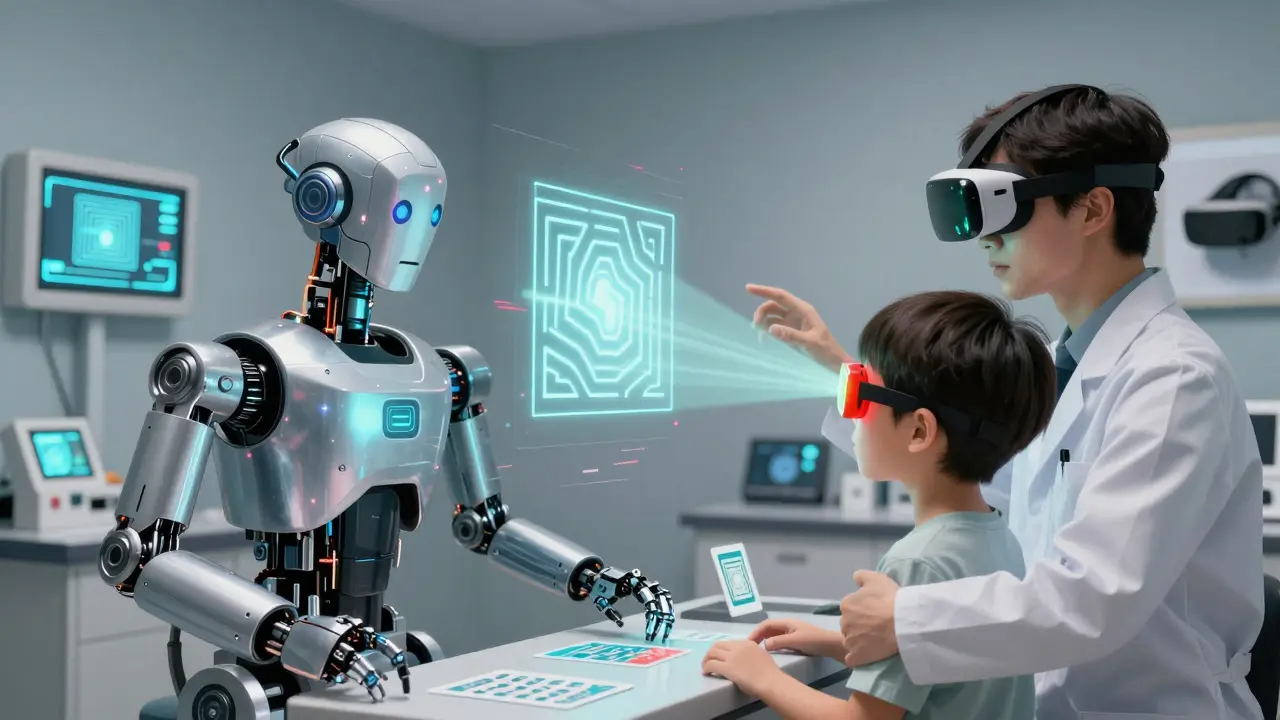
Some optometrists prescribe prism lenses to help with CI. Base-out prisms force the eyes to work harder to converge. Base-in prisms help with reading by reducing eye strain. But here’s the catch: prisms don’t fix the underlying problem. They’re like wearing a brace for a weak ankle-it helps you walk, but it doesn’t strengthen the muscle.
According to the American Association for Pediatric Ophthalmology and Strabismus (AAPOS), prisms can be useful short-term but shouldn’t be used as the main treatment. They’re tiring, can cause dependency, and don’t build lasting neural connections. Think of them as a crutch-not a cure.
What Doesn’t Work (And Why)
There’s a lot of misinformation out there. Let’s clear it up:
- Patching one eye? No. Patching stops both eyes from working together. CI is about teamwork-patching makes it worse.
- Eye exercises from the internet? Sometimes helpful, but rarely enough. Without proper assessment and progression, you’re just spinning your wheels.
- Reading more? More reading without proper eye coordination just makes symptoms worse.
- Waiting it out? CI doesn’t resolve on its own in most cases. Left untreated, it can lead to avoidance of reading, declining school performance, and even permanent suppression of one eye.
Who Needs This Therapy?
CI is most common in children and teens, especially those who spend hours on screens or reading. But adults get it too-especially after concussions, prolonged screen use, or stress. If you or your child:
- Complain of eye strain during reading
- Have headaches after screen time
- Can’t focus for more than 10-15 minutes on close work
- Report double vision or words appearing to move
Then it’s worth getting tested. A comprehensive binocular vision exam takes about 30-45 minutes and includes measurements not done in a standard eye check. If you’ve been told your eyes are “fine” but still struggle, this might be why.
Cost, Time, and Real-World Challenges
Let’s be honest: this isn’t cheap or easy. A full 12-week program typically costs between $2,500 and $4,000. Insurance rarely covers it-only about 1 in 3 private plans do. That’s a huge barrier. Many families delay treatment until symptoms become unbearable.
Time is another hurdle. You need to commit to daily home exercises and weekly visits. For kids, that means parental involvement. Studies show that patients who do 80% or more of their home exercises have an 82% success rate. Those who do less than half? Only 45% improve.
And yes, some kids resist. The exercises can feel boring. The red glasses? Weird. The pencil? Too close. But therapists use games, rewards, and digital tools to keep kids engaged. One parent shared: “After 10 weeks, my 10-year-old went from reading 15 minutes to over an hour without complaining. It changed everything.”
What’s New in 2026?
The field is evolving. In 2023, companies like AmblyoPlay launched remote supervision features, letting therapists monitor progress via video. Early data shows adherence jumped from 52% to 68%. Virtual reality (VR) therapy is also being tested-early trials at SUNY College of Optometry found VR reduced symptom recovery time by 23% compared to traditional methods.
Researchers are now looking at AI-driven personalization. Instead of a one-size-fits-all program, future therapies might adjust difficulty based on real-time eye tracking data. The goal? Shorter treatment time without losing results.
The long-term outlook is strong. The CITT-2 study found 82% of patients maintained their gains one year after treatment. That’s not a fluke-it’s a lasting change.
What Should You Do Next?
If you suspect convergence insufficiency:
- Find a developmental optometrist or vision therapist certified by the College of Optometrists in Vision Development (COVD).
- Ask for a binocular vision assessment-not just a refraction.
- Get the Convergence Insufficiency Symptom Survey (CISS) filled out. It’s a quick, validated tool.
- If diagnosed, start therapy. Don’t wait. The longer you delay, the harder it is to retrain the brain.
- Stick with it. Success isn’t about talent-it’s about consistency.
It’s not magic. It’s neuroscience. And for thousands of people-especially kids who hate reading-it’s the difference between giving up and finally enjoying a book.
Is convergence insufficiency the same as lazy eye?
No. Lazy eye (amblyopia) is when one eye has reduced vision because the brain ignores it. Convergence insufficiency is when both eyes can see clearly but can’t turn inward together to focus on near objects. They’re different problems, though they can occur together. Patching doesn’t help CI-it makes it worse.
Can adults get convergence insufficiency?
Yes. While it’s more common in children, adults can develop CI after head injuries, prolonged screen use, or even high stress. Symptoms like eye strain and double vision during reading are just as real in adults. Therapy works just as well for adults as it does for kids.
How long does vision therapy take to work?
Most people start seeing improvement within 4-6 weeks. Full results usually take 8-12 weeks. The CITT study showed 75% of patients had significant improvement by week 12. But results depend on consistency. Skipping home exercises slows progress.
Does insurance cover convergence insufficiency therapy?
Usually not. Only about 32% of private insurance plans cover vision therapy in the U.S. Some plans cover part of it under “habilitative services,” but many deny it as “not medically necessary.” Always check with your provider before starting. Some therapists offer payment plans.
Can computer programs like AmblyoPlay replace office therapy?
They can help, but they don’t replace it. The CITT study showed office-based therapy with home reinforcement was twice as effective as computer-only programs. Apps are good for reinforcement or if office therapy isn’t available-but they lack personalized feedback, which is key to success.
What happens if convergence insufficiency is left untreated?
Symptoms get worse over time. Kids may avoid reading, fall behind in school, or develop headaches and fatigue. In some cases, the brain starts ignoring one eye (suppression), which can lead to permanent loss of depth perception. Early treatment prevents these long-term effects.

John Cena
Really solid breakdown. I’ve seen this in my nephew-he was labeled 'lazy' in school until his vision therapist caught CI. Took 3 months, but now he reads for fun. No more headaches. Just goes to show: what looks like a behavior issue is often a neurological one.
aine power
Expensive. And unnecessary. Kids these days just need to stop staring at screens.
Ashley Paashuis
Thank you for writing this with such clarity. I’m a pediatric occupational therapist, and I’ve seen too many children misdiagnosed with ADHD when it’s actually convergence insufficiency. The moment their eyes start working as a team, their focus, confidence, and even self-esteem improve. This isn’t just about vision-it’s about access to learning.
Benjamin Fox
Ugh here we go again with the $4k therapy scam 😒
My cousin did pencil push-ups for 2 weeks and it worked fine. Why do these 'specialists' charge so much? Probably because they're just selling placebo nonsense. 🤷♂️
Taylor Mead
Ben, I get where you're coming from-but the data doesn't lie. Pencil push-ups alone? Yeah, some people feel better. But the CITT study? 75% success rate with real therapy vs 43% with home-only. It's like doing bicep curls with one arm and calling it strength training. You're not training the system-you're just going through the motions.
Jonathan Rutter
Let me tell you something no one else will: I was a vision therapist for 14 years. I’ve seen parents cry because their kid finally read a whole book without complaining. I’ve seen adults who hadn’t slept well in years because their eyes were fighting each other every night. This isn’t about money. It’s about brain rewiring. You can’t buy that with a YouTube video. You can’t fake it with an app. It takes human hands, real-time feedback, and a therapist who sees the subtle drift you can’t feel. And yes-it’s expensive. But so is a lifetime of avoiding reading. So is a child failing school because no one looked past the 'attention problem.' You want cheap? Fine. But don’t pretend you’re helping. You’re just delaying the inevitable.
Scott Dunne
As an Irishman, I find this whole 'therapy' industry deeply suspect. We used to just tell kids to look up from their books and get outside. Now we're diagnosing a 'neurological disorder' because they can't stare at a screen for 45 minutes? This is American medical overreach at its finest. My son read War and Peace at 12. No therapy. Just discipline.
Amrit N
Man I had this as a teen and no one knew. I thought I was just bad at reading. Took me 10 years to even realize my eyes were doing that weird double thing. Started therapy at 28. It changed my life. Now I read novels again. I swear, if you're tired after 10 mins of reading-get tested. It's not you. It's your eyes. 💪
Oana Iordachescu
Did you know that the CITT study was funded by the National Eye Institute-which receives funding from pharmaceutical and vision therapy corporations? The 75% success rate? Likely inflated. The placebo effect is powerful. And why are prism lenses called 'crutches'? Because they're being pushed as a temporary fix by a multi-billion dollar industry that profits from lifelong dependency. Who benefits? Not the patient. The system. Always the system.
Jana Eiffel
The philosophical implications of this condition are profound. Convergence insufficiency, as a physiological manifestation of dissonance between sensory input and neural integration, mirrors broader epistemological crises in modern life: the fragmentation of attention, the collapse of sustained cognition, and the alienation of the embodied self from its perceptual apparatus. One cannot help but wonder whether this is not merely a disorder of the ocular musculature, but a symptom of a civilization that has ceased to value depth-literal and metaphorical.
Marie Crick
This is why kids hate reading. Not because they're lazy. Not because they're distracted. Because their eyes are betraying them. And no one notices until they're failing. It's criminal.
Nina Catherine
OMG I just found out my 9yo has this 😭 we thought she was just being dramatic about headaches… we started therapy last week and already she’s reading bedtime stories without groaning. I’m crying. Thank you for this post. I’ll share it with every parent I know 💕
Greg Scott
My daughter’s therapist uses a video game to train convergence. She thinks she’s playing. She’s actually retraining her brain. Genius. And yes, it’s expensive. But cheaper than tutoring for 3 years because she couldn’t read.
Jayanta Boruah
Convergence insufficiency is not a recognized condition in India. We treat such symptoms with Ayurvedic eye exercises and pranayama. The American medical complex thrives on pathologizing normal human variation. A child who reads slowly is not ill-he is contemplative. Your diagnostic obsession is a cultural artifact, not a scientific truth.
Caleb Sciannella
While the clinical evidence for office-based therapy is robust, we must also consider accessibility. In rural America, in developing nations, and in underinsured communities, the gold standard is unattainable. We cannot dismiss home-based protocols as 'ineffective'-we must improve them. The future lies not in replacing office therapy, but in augmenting it with AI-guided, remotely monitored systems that preserve fidelity while expanding reach. The goal is not to choose between efficacy and equity-but to design systems that deliver both.