
Picture this: you’re caring for a loved one who relies on a feeding tube to get the nutrition they need. It’s a lifeline. But then comes the daily puzzle of getting their essential medications into that same narrow pathway without causing a blockage or ruining the drug’s effectiveness. This isn’t just about convenience; it’s a critical safety issue. Every year, thousands of patients face complications simply because a pill was crushed incorrectly or flushed with too little water.
The reality is stark. Improper administration can lead to treatment failure in up to 30% of cases. When we talk about enteral feeding, we are talking about delivering food and medicine directly into the gastrointestinal tract through tubes like nasogastric (NG) or gastrostomy (G-tube) systems. The stakes are high because these tubes are narrow-often no wider than a straw-and easily clogged by stubborn medication residues. Getting this right requires more than good intentions; it demands strict adherence to compatibility rules and flushing protocols established by major health organizations like the American Society for Parenteral and Enteral Nutrition (ASPEN) and the FDA.
Understanding Tube Mechanics and Medication Forms
To keep a tube open, you first have to understand what you’re dealing with. Not all pills are created equal, and not all tubes are the same size. Most enteral feeding tubes range from 5 to 16 French in diameter. For context, a French unit is roughly one-third of a millimeter. So, an 8-French tube-which is common for long-term use-has an internal width of only about 2.7 millimeters. That is incredibly small. If you try to push a gritty, semi-dissolved tablet through that space, it will stick. And once it sticks, it becomes a plug that is nearly impossible to remove without removing the tube entirely.
The form of the medication matters just as much as the tube size. Immediate-release tablets generally break down well when crushed and mixed with water. Studies show that about 78% of immediate-release tablets dissolve adequately within five minutes. Extended-release (ER) or sustained-release formulations are a different story. These are designed to release drugs slowly over hours. Crushing them destroys that mechanism, dumping the entire dose at once. This can cause toxic side effects or, conversely, if the drug doesn't dissolve properly, result in zero absorption. In fact, only 32% of extended-release products dissolve adequately even under ideal conditions.
Then there are enteric-coated pills. These have a special shell that protects the drug from stomach acid until it reaches the intestines. Crushing an enteric-coated pill exposes the drug to acid prematurely, which can destroy the medication or irritate the stomach lining. Capsules containing pellets, like duloxetine, also pose risks. Those pellets are often individually coated for a reason. Opening the capsule and pouring the beads into a tube might seem harmless, but many of those beads are too large to pass through standard feeding tubes, leading to instant blockages.
The Golden Rule of Flushing
If there is one thing every caregiver and nurse must memorize, it is the flushing protocol. Water is your best friend here. It clears the tube before, during, and after medication administration. Skipping this step is the number one cause of tube occlusion.
Here is the standard protocol recommended by institutions like the Cleveland Clinic:
- Before Medication: Flush with at least 15-30 mL of warm water. This clears any residual formula or previous meds.
- Between Medications: Flush with 15 mL of water between each individual drug. Never mix two medications together in the syringe unless you have verified they are compatible. Mixing can cause chemical reactions that create precipitates-solid chunks that will clog the tube.
- After All Medications: Flush again with 15-30 mL of water to ensure every trace of the last drug has passed through.
A helpful rule of thumb is to use at least 15 mL of water for every 10 mL of liquid medication administered. Why warm water? Cold water can cause the tube material to contract slightly, while hot water can damage the plastic. Room temperature or slightly warm water keeps the tube pliable and helps dissolve medications faster.
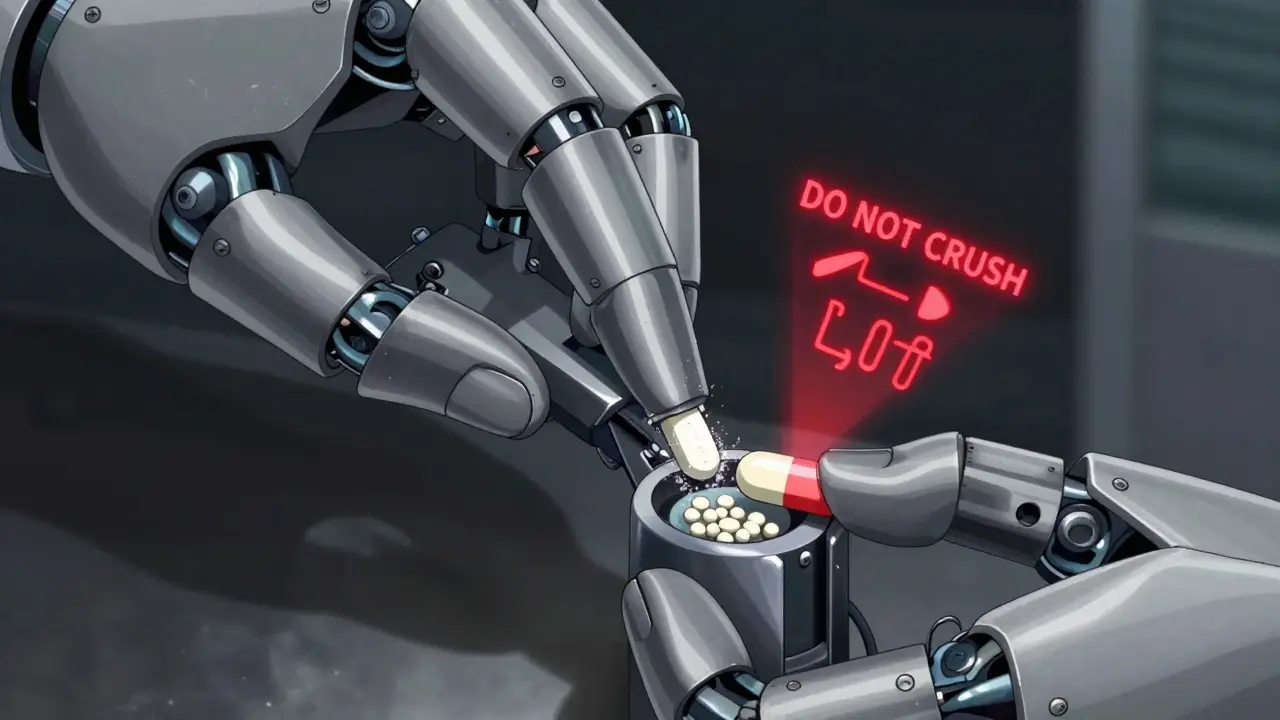
Medications You Should Never Crush
Some medications are strictly off-limits for crushing or opening. Administering these via a feeding tube without proper formulation changes can be dangerous. Here are specific examples you need to watch out for:
| Medication Name | Brand Example | Reason for Restriction |
|---|---|---|
| Mycophenolate | Cellcept® | Enteric-coated granules; crushing causes toxicity and reduces efficacy. |
| Valganciclovir | Valcyte® | Not suitable for enteral tube; risk of incomplete delivery. |
| Finasteride | Proscar® | Risk of toxic exposure if coating is broken. |
| Bulk-forming Laxatives | Metamucil® (Psyllium) | Expands rapidly in water; causes immediate, hard-to-clear obstruction. |
| Duloxetine | Cymbalta® | Capsules contain enteric-coated pellets that do not fit through tubes. |
If a patient needs one of these drugs, the healthcare team must find an alternative. Sometimes a liquid version exists. Other times, a different drug class with similar effects is prescribed. Never assume a pill can be crushed just because it looks soft. Always check with a pharmacist or consult a reliable database like the NIH’s evaluation of oral medications for feeding tube appropriateness.
Drug-Feed Interactions: To Pause or Not?
For years, the standard advice was to stop feeding for one hour before and after giving certain medications. The fear was that the protein and minerals in the formula would bind to the drug, preventing absorption. However, recent evidence challenges this blanket approach.
The ASPEN Drug-Nutrient Interaction Task Force reviewed the data and found that withholding tube feedings actually provides a clinical benefit for very few drugs. The primary exception is levodopa, used for Parkinson’s disease, where protein interference is significant. For most other medications, continuous feeding does not significantly impact drug levels. Stopping feeds unnecessarily can lead to dehydration, electrolyte imbalances, and discomfort for the patient.
That said, some drugs still require attention. Tetracyclines like doxycycline can bind to calcium and magnesium found in formulas. While you don’t necessarily need to stop the feed for an hour, ensuring adequate flushing and monitoring serum drug levels is wise. Always follow the specific instructions provided by the prescribing physician or hospital protocol, as individual patient factors may vary.

Practical Steps for Safe Administration
Safety starts with verification. Before you administer anything, you must confirm the tube is in the right place. For nasogastric tubes, this usually means checking the pH of aspirated gastric contents (a pH of 1-5 indicates stomach placement) or using radiographic confirmation. Never rely solely on air insufflation and listening for bubbles-that method is unreliable and dangerous.
When preparing the medication:
- Crush properly: Use a dedicated pill crusher. Mortar and pestle can leave large shards. Crush the pill into a fine powder.
- Reconstitute fully: Mix the powder with a small amount of water in a cup. Stir vigorously until no particles remain. Let it sit for a minute to ensure full dissolution.
- Draw up carefully: Pour the mixture into a large-bore syringe. Avoid trapping air bubbles.
- Administer slowly: Push the plunger gently. If you meet resistance, stop immediately. Do not force it. Forcing a blocked tube can rupture it or injure the patient’s tissue.
Documentation is part of the safety net. Record the volume of water used for flushing, the method of preparation, and confirmation of tube placement. This creates a trail that helps identify issues if a complication arises later.
What to Do When Things Go Wrong
Despite best efforts, blockages happen. They occur in about 12-15% of patients annually, with medication being the culprit in 65% of those cases. If you suspect a blockage:
- Stop immediately. Do not keep pushing.
- Try gentle irrigation: Use warm water and a small syringe (5-10 mL) to gently flush. Sometimes warmth helps dissolve residue.
- Contact a professional: If water doesn’t work, call the nurse or doctor. They may use enzymatic solutions (like pancreatic enzymes) or carbonated beverages to break down the clog. Never use sharp objects to poke inside the tube.
Prevention is always easier than cure. Rushing is the enemy. As the Veterans Affairs safety initiative reminds staff: “Don’t be in a rush to crush, know before you tube!” Taking an extra five minutes to verify compatibility and flush thoroughly saves hours of medical intervention later.
Can I mix multiple medications in one syringe for my feeding tube?
Generally, no. Mixing medications can cause chemical interactions that create solid precipitates, which will clog the tube. Unless a pharmacist has explicitly confirmed that two specific drugs are compatible, administer them separately with a 15 mL water flush between each one.
How do I know if a pill is safe to crush?
Look for labels like "Extended Release," "Sustained Release," "Enteric Coated," or "ER/SR." These should never be crushed. If the label doesn't say, consult a pharmacist or use a resource like the NIH's enteral medication database. When in doubt, ask for a liquid alternative.
Why is warm water better for flushing than cold water?
Warm water helps dissolve medication residues more effectively than cold water. Additionally, extreme temperatures can affect the integrity of the tube material; cold may cause slight contraction, while hot water can warp the plastic. Room temperature or slightly warm water is ideal.
Do I need to stop feeding before giving medication?
For most medications, no. Recent guidelines from ASPEN suggest that withholding feeds is only clinically necessary for a few drugs, primarily levodopa. For others, continuous feeding is safe as long as you follow proper flushing protocols. Always check specific drug instructions, however.
What should I do if I feel resistance when pushing medication?
Stop immediately. Do not force the plunger. Forcing it can rupture the tube or injure the patient. Try flushing gently with warm water. If the resistance remains, contact a healthcare provider for further assistance, such as enzymatic de-clogging methods.
