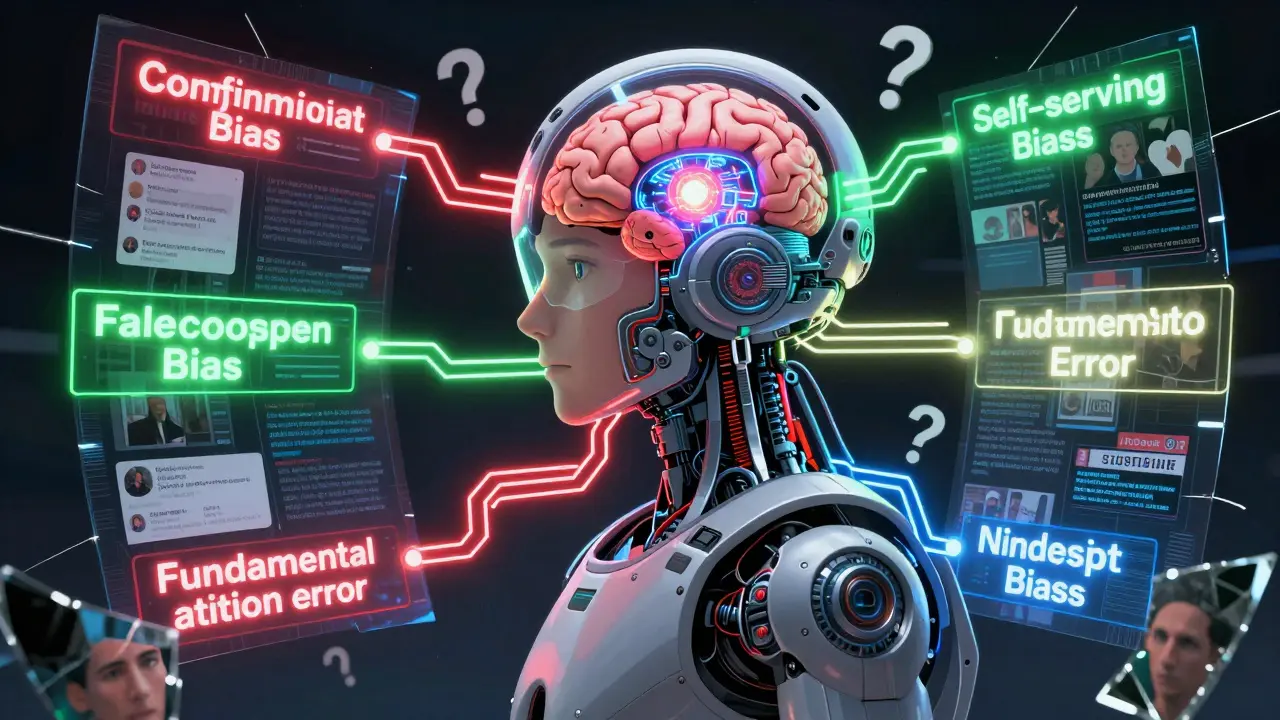
Every time you scroll through social media and instantly agree with a post that matches your view, or dismiss a news article because it challenges your opinion, you’re not being irrational-you’re being human. Your brain is wired to take shortcuts. These shortcuts are called cognitive biases, and they shape how you interpret the world, respond to others, and even make life-altering decisions-often without you realizing it.
Why Your Brain Prefers Comfort Over Accuracy
Your brain didn’t evolve to find truth. It evolved to keep you alive. Back in the savannah, making a quick call-like assuming a rustle in the grass was a predator-was safer than pausing to check if it was just the wind. That instinct still runs your mind today. When you hear something that fits your existing beliefs, your brain lights up with a reward signal. When you hear something that contradicts it? Your brain treats it like a threat. This isn’t just theory. A 2023 meta-analysis from the American Psychological Association found that 97.3% of human decisions are influenced by cognitive biases. That means almost every choice you make-from what you buy, who you trust, to how you react in an argument-is filtered through a set of mental shortcuts you didn’t even know you had.The Big Five Biases That Shape Your Responses
Not all biases are the same. Some quietly nudge your opinions. Others completely warp your perception. Here are the five that most directly affect how you respond to everyday information:- Confirmation bias: You notice, remember, and accept information that supports what you already believe. A 2021 meta-analysis in Psychological Review found this bias has the strongest effect on responses, with an effect size of d=0.87. In one study, people exposed to opposing political views showed 63.2% higher stress levels and were 4.3 times more likely to label the source as "biased," even if it was credible.
- Self-serving bias: You take credit for successes but blame outside forces for failures. Managers who use this bias attribute team wins to their leadership 78.4% of the time, but blame market shifts or bad luck for losses 82.1% of the time. The result? Teams with these managers have 34.7% higher turnover, according to a 2023 Harvard Business Review study.
- False consensus effect: You assume everyone thinks like you. Research shows people overestimate agreement with their views by an average of 32.4 percentage points. If you think "everyone knows climate change is urgent," you’re likely wrong-by a lot.
- Fundamental attribution error: You see others’ mistakes as character flaws but your own as circumstances. If someone cuts you off in traffic, they’re rude. If you do it, you were in a hurry. A 2022 meta-analysis found people attribute 68.3% of others’ behavior to personality, but only 34.1% of their own.
- Hindsight bias: After something happens, you swear you saw it coming. In a classic 1993 study, students were asked to predict U.S. Senate votes. After the votes were revealed, over half claimed they "knew it all along"-even though their initial predictions were wildly off.
How Biases Hurt Real-World Outcomes
These aren’t just party tricks for psychologists. They have real consequences. In healthcare, diagnostic errors caused by cognitive bias account for 12-15% of adverse events, according to Johns Hopkins Medicine. A doctor who expects a patient to have the flu might miss the early signs of pneumonia because the symptoms don’t match their mental model. In courtrooms, confirmation bias leads to wrongful convictions. The Innocence Project found that eyewitness misidentification-often fueled by expectation bias-played a role in 69% of DNA-exonerated cases. In finance, optimism bias makes people think they’ll beat the market. A 2023 Journal of Finance study tracked 50,000 retail investors and found those who underestimated their risk by 25% or more earned 4.7 percentage points less annually than those who stayed grounded in data. Even your relationships suffer. If you believe your partner is "selfish," you’ll interpret every quiet evening as proof. If you think your coworker is "lazy," you’ll notice every missed deadline and ignore the times they pulled extra hours. Your brain doesn’t just filter information-it filters people.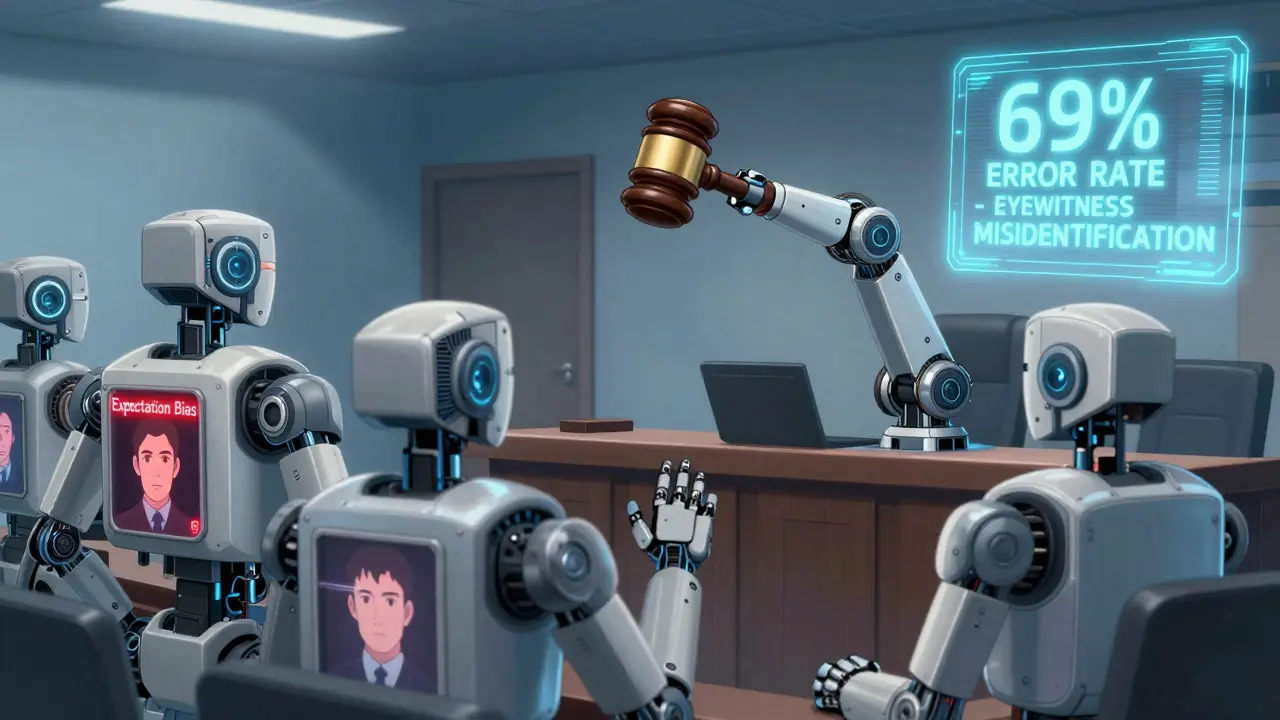
Why Knowing About Biases Doesn’t Help-Unless You Act
You’ve probably heard "be aware of your biases." But awareness alone doesn’t change behavior. A 2002 Princeton study found that 85.7% of people think they’re less biased than others. That’s called the "bias blind spot." And it’s why most training programs fail. The real fix? Structure. You need systems to override your instincts.- Consider the opposite: Before making a decision, spend five minutes writing down reasons why your initial thought might be wrong. University of Chicago researchers found this reduces confirmation bias by 37.8%.
- Use checklists: Medical teams using mandatory alternative-diagnosis checklists reduced diagnostic errors by 28.3% across 15 hospitals. The same works for hiring, investing, or even choosing a new phone.
- Slow down your responses: When you feel a strong emotional reaction to something, wait 20 seconds before replying. That’s enough time to activate your analytical brain and bypass your automatic response.
- Seek disconfirming evidence: If you’re researching a topic, deliberately read the strongest argument against your view. Not to debate it-to understand it.
What’s Changing Now: Tech, Regulation, and Training
The world is starting to catch up. In 2024, the FDA approved the first digital therapy for cognitive bias modification, developed by Pear Therapeutics. It’s not a pill-it’s an app that trains your brain to spot and correct biased thinking. The European Union’s AI Act, effective February 2025, requires all high-risk AI systems to be tested for cognitive bias. If an algorithm recommends loans or hires employees, it must prove it’s not favoring certain groups based on hidden assumptions. Google’s "Bias Scanner" API now analyzes over 2.4 billion queries a month, flagging language that reflects belief-driven distortions. IBM’s Watson OpenScale reduces bias in AI decisions by 34.2% by monitoring how human inputs influence outcomes. And it’s not just tech. Twenty-eight U.S. states now require high school students to learn about cognitive biases as part of their curriculum. The goal? To build a generation that doesn’t just consume information-but questions how they process it.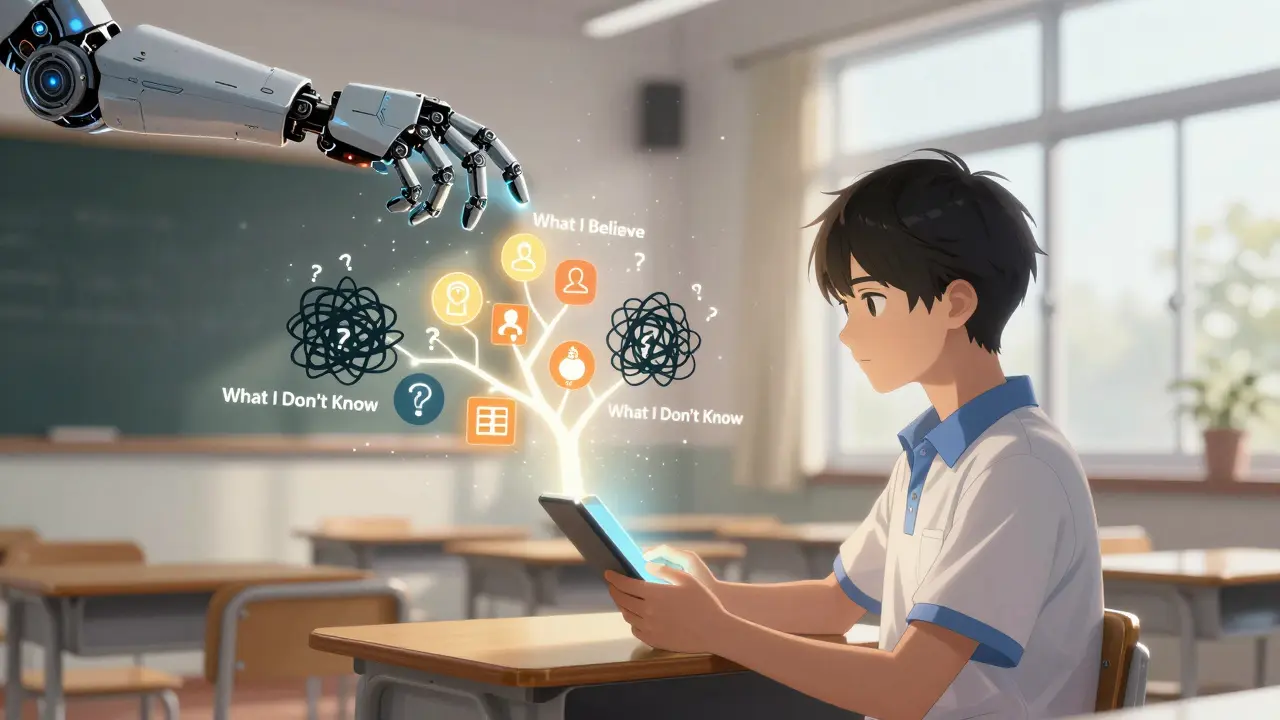
What You Can Do Today
You don’t need an app or a corporate program to start. Just begin with one habit: Every time you respond to something-whether it’s a comment, a news headline, or a colleague’s idea-ask yourself: "Is this reaction based on what I know, or what I believe?" Then, pause. Look for one piece of evidence that contradicts your view. Not to change your mind-to test it. Cognitive biases aren’t flaws. They’re features of a brain designed for speed, not accuracy. But in a world full of complex decisions, speed without accuracy is dangerous. The best thinkers aren’t the ones with the most knowledge. They’re the ones who know when to question their own instincts.Are cognitive biases the same as stereotypes?
No. Stereotypes are generalized beliefs about groups of people-like assuming all teenagers are reckless. Cognitive biases are mental shortcuts that affect how you process *any* information, whether it’s about people, numbers, or events. Stereotypes can be fueled by biases like the fundamental attribution error or in-group/out-group bias, but not all biases are about people. For example, anchoring bias makes you rely too heavily on the first number you hear, even if it’s irrelevant.
Can you eliminate cognitive biases completely?
No-and you shouldn’t try. Biases helped our ancestors survive. The goal isn’t to remove them, but to recognize them before they lead to bad decisions. Even experts fall for them. The key is building habits that create space between your instinct and your response.
Why do some people seem less biased than others?
People who score high on the Cognitive Reflection Test-meaning they’re better at overriding their first instinct-show 28.9% fewer diagnostic errors in medical settings, according to a University of Michigan study. It’s not about intelligence. It’s about training yourself to pause, question, and double-check. Anyone can learn this skill.
How do cognitive biases affect AI systems?
AI learns from human data-and humans are biased. If a hiring algorithm is trained on past hires who were mostly men, it will learn to favor men. This isn’t a glitch-it’s a mirror. That’s why the EU’s AI Act now requires bias testing. The solution isn’t to remove AI, but to audit its inputs and force it to consider alternative outcomes.
Is there a quick fix for confirmation bias?
Yes-try the "consider the opposite" technique. Before sharing a strong opinion, write down two credible reasons why you might be wrong. Do this for a week, and you’ll notice your responses become more measured. Studies show this cuts confirmation bias by nearly 40%.

Phil Davis
So we’re all just meat computers running outdated software with no update button? Cool. Guess I’ll keep scrolling past the truth until my dopamine hits a new high.
At least I’m not the guy yelling at the weather app for being wrong.
Irebami Soyinka
USA brainwashing its own people with this soft colonial psychology nonsense 😂
Back home in Nigeria, we don’t need ‘bias scanners’-we just know when someone is lying to your face and still smile.
Y’all need therapy, not checklists. 🤭
Mel MJPS
I love how this post doesn’t just list biases but gives real ways to fight them. I started doing the ‘consider the opposite’ thing last week-and wow, my partner noticed I stopped interrupting during arguments. Small change, big difference.
Also, I cried reading the part about relationships. So true.
Katie Mccreary
You’re all just performing self-awareness. The fact you’re reading this means you think you’re above it. Classic bias.
Also, your checklist is useless if you don’t track your actual decisions. Do you even log your choices? No. You’re just here for the dopamine hit of feeling enlightened.
Kevin Kennett
Listen. I used to be the guy who thought I was the least biased. Then I started asking my team: ‘What’s one thing I got wrong this week?’
Turns out, I dismissed three solid ideas because they ‘didn’t fit my vision.’
Now I have a whiteboard in my office that says ‘What am I missing?’
It’s not magic. It’s just uncomfortable as hell. But it works.
Jess Bevis
Biases aren’t American. They’re human. In Japan, we call it ‘honne and tatemae’-the gap between what you feel and what you say. Same thing. Just different packaging.
Global problem. Global fix.
Mark Alan
THEY’RE USING AI TO MANIPULATE OUR THOUGHTS?? 😱
THE EU IS WATCHING US??
THE GOVERNMENT IS TRAINING TEENS TO QUESTION THEIR OWN MINDS??
THIS IS THE BEGINNING OF A NEW WORLD ORDER!! 🤯🇺🇸🔥
Robert Cardoso
Let’s be clear: cognitive bias is just a sanitized term for ‘stupidity.’
You didn’t evolve to find truth-you evolved to survive long enough to reproduce. That’s why 97% of decisions are garbage.
And no, ‘consider the opposite’ won’t fix your existential laziness. Only suffering will.
And even then, you’ll probably blame the suffering on someone else.
That’s the real bias: thinking you can fix it with a checklist.
matthew martin
Man, I read this at 3am after my third coffee and suddenly remembered why I stopped arguing with my uncle on Facebook.
He’s not wrong-he’s just trapped in his own mental echo chamber.
And I used to be the same way. Now I just say ‘huh, interesting’ and change the subject.
Turns out, peace is cheaper than being right.
Also, I now use a checklist for buying phones. No more ‘I just felt like it’ purchases.
Surprisingly, my wallet and my sanity thank me.
Jeffrey Carroll
Thank you for this thoughtful, well-researched piece. It is a rare and valuable contribution to public discourse. I believe that cultivating metacognitive awareness is not merely an individual practice but a societal imperative. The integration of such concepts into educational curricula is a promising step toward a more resilient and rational citizenry.