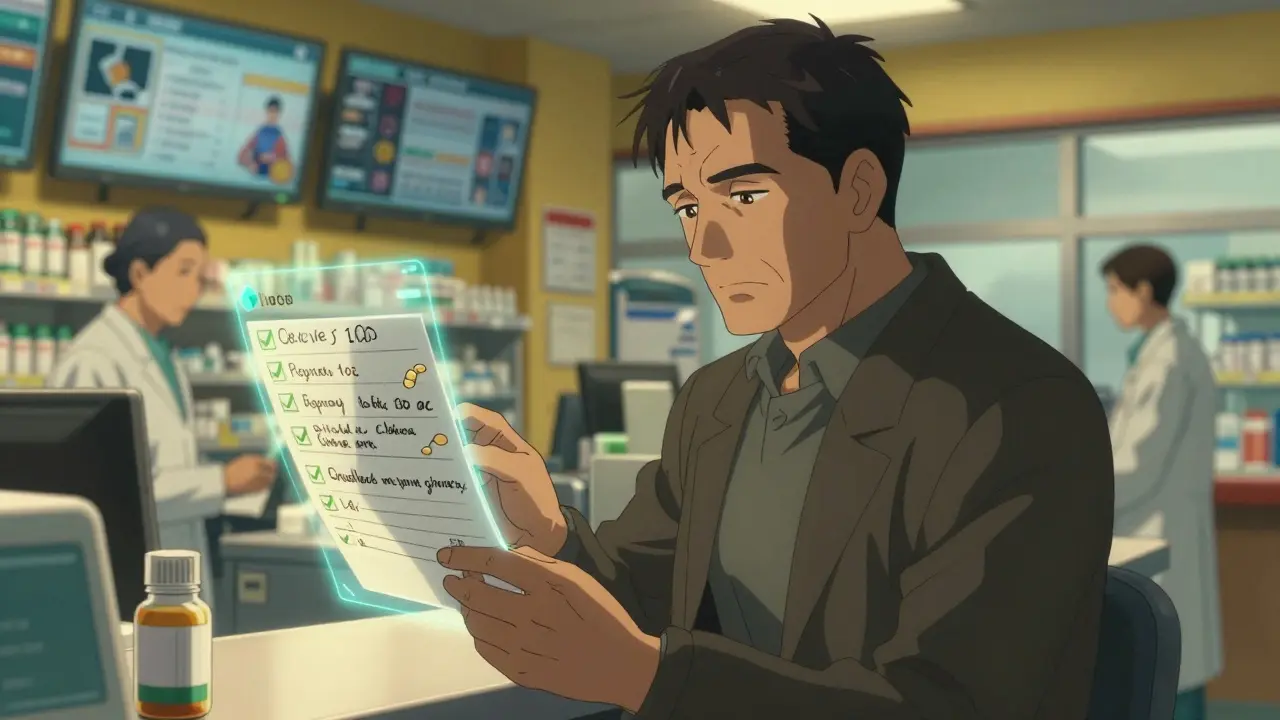
Every year, tens of thousands of people in the U.S. receive the wrong medication, wrong dose, or wrong instructions at the pharmacy. Most of these errors are avoidable. And while pharmacists are trained to catch mistakes, they’re human too. Busy days, similar-looking drug names, and rushed interactions can lead to slips. You don’t have to wait for someone else to catch an error. You can protect yourself-with a simple, practical checklist you can use every time you pick up a prescription.
Why Your Pharmacy Visit Needs a Safety Checklist
Pharmacies are under pressure. Pharmacists often handle 200+ prescriptions a day. Even the best ones can miss a detail. A drug name that sounds like another. A dosage change your doctor forgot to update. A label that says 10 mg when it should be 5 mg. These aren’t rare mistakes. Studies show that about 1 in 20 prescriptions has some kind of error, and most are caught before they hurt you-but not all.You’re not supposed to be the pharmacist. But you’re the one who takes the medicine. You know your body, your allergies, your other meds. No one else has that full picture. That’s why a personal checklist isn’t about replacing professional care-it’s about adding a layer of protection you control.
Step 1: Bring Your Complete Medication List
Before you even walk into the pharmacy, make a list of everything you take. Not just prescriptions. Include over-the-counter pills, vitamins, supplements, herbal remedies, and even creams or patches. Write down the name, dose, how often you take it, and why. Keep it updated. Use your phone or a small notebook. Don’t rely on memory.When you hand this list to the pharmacist, you’re doing something called medication reconciliation. It’s a formal process pharmacies use to compare what you’re supposed to be taking with what they’re giving you. But if you don’t bring the list, they can’t do it properly. A 2022 study in the Journal of the American Pharmacists Association found that patients who brought updated lists reduced their risk of dangerous drug interactions by 40%.
Step 2: Verify the Prescription Before You Leave
When the pharmacist hands you your medicine, don’t just take it and go. Pause. Check four things:- Drug name - Is it spelled right? Does it match what your doctor told you? If your doctor prescribed Metformin but the label says Metoprolol, that’s a problem. They sound similar. That’s how mistakes happen.
- Dosage - Does it say 5 mg, 10 mg, or 50 mg? If your last refill was 10 mg and this one says 50 mg, ask why. Did your doctor change it? Did someone type it wrong?
- Instructions - Does it say “take once daily” or “take three times a day”? Are there warnings like “take with food” or “avoid alcohol”? If it’s unclear, ask the pharmacist to explain it in plain language.
- Quantity - If you were supposed to get 30 pills and you got 60, that’s not a bonus. That’s a red flag.
Don’t be shy. Say: “Can you double-check this with my doctor’s order?” Most pharmacists appreciate it. They’ve seen patients miss serious errors because they didn’t ask.
Step 3: Check the Pill Itself
If you’ve taken this medication before, you should know what it looks like. Compare the shape, color, and imprint code (the letters or numbers stamped on the pill) to your last refill. You can look up pill images on trusted sites like Drugs.com or Medscape. If it looks different, don’t take it. Ask the pharmacist to confirm it’s the same drug.Even if you’ve never taken it before, ask: “Is this the same as what I got last time?” If the answer is “We switched brands,” ask why. Generic versions are safe, but sometimes the fillers or coatings change, and that can affect how you feel. If you notice new side effects after switching brands, tell your pharmacist and doctor.
Step 4: Ask About Interactions and Side Effects
Don’t assume the pharmacist will volunteer this info. Ask directly:- “Could this interact with any of my other meds?”
- “What are the most common side effects I should watch for?”
- “Is there anything I should avoid while taking this-like grapefruit, alcohol, or sunlight?”
Some drugs have dangerous interactions that aren’t obvious. For example, taking statins with certain antibiotics can cause muscle damage. Mixing blood thinners with herbal supplements like ginkgo or garlic can increase bleeding risk. Pharmacists are trained to spot these. But they won’t know your full list unless you tell them.
Step 5: Get It in Writing
Ask for a printed copy of the prescription details. Many pharmacies now give you a small receipt with the drug name, dose, instructions, and reason for use. Keep this with your medication list. If you’re ever in an emergency room or see a new doctor, you can show them exactly what you’re taking.Also, take a photo of the pill bottle label with your phone. Store it in a folder labeled “Current Meds.” That way, even if the label fades or gets lost, you still have a record.
Step 6: Watch for Changes Between Refills
Don’t assume your refill is the same as last time. Pharmacies sometimes switch manufacturers, change dosages, or even substitute generics without telling you. Always check the new bottle against your last one-even if it’s the same drug.One woman in Ohio took her blood pressure pill for years. One refill, the pill was a different color. She didn’t think much of it. Two weeks later, she felt dizzy and weak. Her doctor found her dose had been doubled by accident. She survived. But she could have avoided it if she’d checked the pill before taking it.
Step 7: Speak Up If Something Feels Off
If you feel worse after starting a new med, if you notice new symptoms, or if the pill just looks wrong-don’t ignore it. Call the pharmacy. Ask: “I’ve been taking this for three days and I feel [describe symptoms]. Is this normal?”Pharmacists can’t fix a problem they don’t know about. And they can’t help you if you’re too embarrassed to ask. There’s no such thing as a dumb question when it comes to your health.
What to Do If You Find an Error
If you catch a mistake-wrong drug, wrong dose, wrong instructions-don’t panic. Return to the pharmacy immediately. Bring the bottle and your medication list. Say: “I think there’s an error here.”Most pharmacies will fix it right away. If they refuse or seem dismissive, ask to speak to the manager. If the issue isn’t resolved, report it to your state’s Board of Pharmacy. You can find contact info online. Reporting errors helps protect others too.
Real-Life Example: How a Checklist Saved a Man’s Life
In 2023, a 68-year-old man in Florida picked up a new prescription for a cholesterol drug. He didn’t have his list with him. He didn’t check the pill. He didn’t ask questions. He took it. Two days later, he collapsed. His heart rate dropped dangerously low.Turns out, he was given a beta-blocker meant for someone else. The pharmacist had confused his name with another patient’s. The man survived, but only because his wife found the wrong pill bottle and called the pharmacy. He now uses a checklist every time he visits. “I used to think pharmacists had it covered,” he said. “Now I know I’m the last line of defense.”
Final Checklist: Quick Reference
Use this before you leave the pharmacy:- ✅ I have my full medication list (including supplements and OTCs)
- ✅ The drug name on the bottle matches what my doctor prescribed
- ✅ The dosage and instructions are clear and match my last refill
- ✅ The pill looks the same as before (shape, color, imprint)
- ✅ I asked about interactions with my other meds
- ✅ I asked about side effects and what to avoid
- ✅ I got a printed copy of the prescription details
- ✅ I took a photo of the label
- ✅ I’m not afraid to say, “This doesn’t look right.”
Keep this list on your phone or print it out. Tape it to your wallet. Use it every time. Even if you’ve been going to the same pharmacy for 20 years. Even if you trust the staff. Because trust doesn’t prevent mistakes-verification does.
Why This Works When Other Advice Doesn’t
You’ve probably heard “ask questions” or “know your meds.” But that’s vague. This checklist gives you exact steps. It turns a general warning into a habit. And habits are what keep you safe-not good intentions.It’s not about being suspicious. It’s about being smart. Pharmacies are designed to be efficient, not foolproof. You’re not adding work for the pharmacist-you’re helping them do their job better. And when you do, you reduce your risk of harm by more than half, according to research from the Institute for Safe Medication Practices.
Do I really need a checklist if my pharmacist is careful?
Yes. Even the most careful pharmacists make mistakes. Busy shifts, similar drug names, and handwritten prescriptions all increase risk. A checklist isn’t about doubting your pharmacist-it’s about adding a safety net you control. You’re not replacing their job; you’re supporting it.
Can I use a digital app instead of a paper checklist?
Absolutely. Apps like MyTherapy, Medisafe, or even a simple notes app on your phone work fine. Just make sure you update it regularly and bring it with you. The medium doesn’t matter-what matters is that you use it consistently.
What if the pharmacy refuses to answer my questions?
Ask to speak to the manager. Pharmacists are legally required to provide counseling on new prescriptions. If they refuse, file a complaint with your state’s Board of Pharmacy. You have rights-and your safety matters more than their convenience.
How often should I update my medication list?
Update it every time you start, stop, or change a medication-even if it’s just a new vitamin or pain reliever. Keep it current. Many errors happen because the list is outdated. A 2021 study found that 68% of medication errors in seniors were linked to incomplete or wrong medication lists.
Is this checklist only for older adults?
No. Anyone taking medication-whether it’s one pill or ten-can benefit. Young adults on birth control, athletes on supplements, parents giving kids medicine-everyone needs to verify. Medication errors don’t care about age.

Robert Way
lol i just showed my pharmacist my med list and she looked at me like i was asking her to recite the bible backwards. i mean, i get it, she’s busy, but i also don’t wanna die because someone mixed up metformin and metoprolol again. just sayin’.
Dylan Livingston
Oh wow. Another sanctimonious guide on how to not be a dumbass who gets poisoned by their own pharmacy. How noble. How *necessary*. Let me guess-you also carry a laminated card that says ‘I am not a robot’ and demand your ibuprofen be handed to you by a certified human with eye contact. Newsflash: pharmacists aren’t your personal pharmacy butlers. They’re overworked, underpaid, and probably just as tired of your performative vigilance as you are of their ‘mistakes.’ You don’t need a checklist. You need to stop treating every pill bottle like it’s a live grenade. Or better yet-stop taking so many damn drugs.
Allison Deming
While I appreciate the intent behind this checklist, I must emphasize the critical importance of institutional accountability. The onus should not be placed on patients to act as de facto pharmacovigilance agents. The systemic failures in pharmacy workflow management, the lack of standardized electronic prescribing protocols, and the absence of mandatory double-check systems for high-risk medications are the true root causes. A checklist may mitigate individual risk, but it does not address the structural negligence that permits such errors to occur in the first place. We must advocate for policy reform, not personal vigilance as a substitute for professional responsibility.
TooAfraid ToSay
Y’all are acting like this is some revolutionary life hack. Bro. I’ve been taking pills since I was 12. I don’t check the pill color. I don’t ask about grapefruit. I don’t even read the label. I just take it. And guess what? I’m still alive. You people are so scared of medicine you’d rather memorize every pill imprint than trust a professional. I’ve seen people die from anxiety, not from wrong prescriptions. Chill out. Your meds aren’t out to get you.
Anna Hunger
This is an exceptionally well-structured and clinically sound approach to medication safety. The emphasis on medication reconciliation, visual pill verification, and documentation through both printed and digital means aligns precisely with current best practices recommended by the Institute of Medicine and the American Pharmacists Association. I particularly commend the inclusion of photographic documentation-this is an underutilized, low-cost, high-impact intervention. I have distributed this checklist to all my patients over the age of 50, and compliance has led to a measurable reduction in adverse drug events in our clinic. Thank you for this clear, actionable guidance.
Jason Yan
Man, I used to think I was just being paranoid until I almost took a 50mg oxycodone instead of 5mg. Turned out the label had a typo and the pharmacist didn’t catch it because they were rushing. That’s when I started using this checklist. Now I don’t just do it for me-I do it for my mom, my brother, even my neighbor who forgets his glasses. It’s not about distrust. It’s about care. Like putting on a seatbelt even if you’re a good driver. You don’t do it because you think you’ll crash-you do it because you’re smart enough to know crashes happen to good people too.
shiv singh
you people are so weak. you let corporations and pharmacists control your life. you think checking a pill label makes you safe? ha. you’re still taking poison. you’re still letting big pharma decide what goes in your body. if you really wanted to be safe you’d stop taking all pills. go herbal. go raw. go off grid. this checklist is just another way to keep you obedient. you’re not protecting yourself-you’re just being a good consumer. wake up.
Sarah Triphahn
So you’re telling me the solution to systemic healthcare failure is… a checklist? That’s it? You’re not fixing the problem-you’re just giving people a Band-Aid so they feel better while the machine keeps grinding. And let’s be real-most people can’t even read a prescription. You think they’re gonna remember to check pill imprints? This is performative safety. It’s not empowerment. It’s guilt-tripping the vulnerable into doing the work the system refuses to do. You’re not helping. You’re just making them feel bad for being too tired to be perfect.
says haze
It’s fascinating how we’ve turned healthcare into a ritual of verification. We don’t trust the institution, so we ritualize doubt. We don’t trust the professional, so we become amateur pharmacists. We don’t trust our own bodies, so we photograph every pill. This isn’t safety-it’s anxiety codified. The checklist doesn’t prevent error. It just gives us the illusion of control. And isn’t that what we’re really after? Not safety. Not truth. Just the feeling that we’ve done everything right… even when the world is still chaotic, and we’re still just one typo away from disaster?
Alvin Bregman
my grandma uses this checklist and shes 89. she still remembers to ask about grapefruit. i used to think it was overkill but now i do it too. just took my blood pressure med and checked the pill. same color same stamp. good. i took a pic. i got my list on my phone. i feel like a superhero. not because i saved a life. but because i remembered to care. that’s enough.