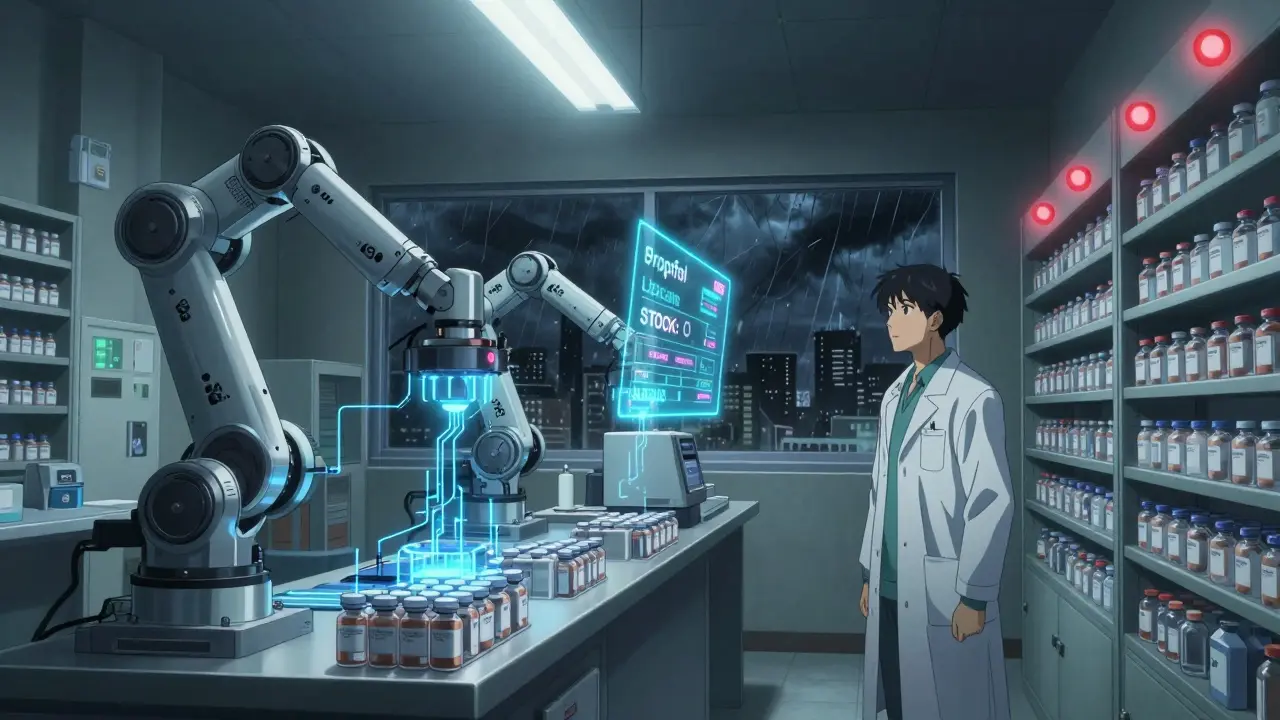
When a patient in intensive care needs a life-saving injection, and the vial isn’t there, the problem isn’t just a missing stock item-it’s a crisis that ripples through every corner of the hospital. Injectable medication shortages aren’t occasional hiccups anymore. They’re a persistent, growing emergency, and hospital pharmacies are the ones bearing the heaviest burden. While retail pharmacies might run low on a popular antibiotic now and then, hospitals are facing weeks or months without critical drugs like anesthetics, chemotherapy agents, and IV fluids. These aren’t optional meds. They’re what keep people alive during surgery, cancer treatment, or a heart attack.
Why Injectables Are the First to Go Missing
Not all drugs are created equal when it comes to supply chain fragility. Sterile injectables-medications that must be free of bacteria and manufactured in ultra-clean environments-are the most vulnerable. They make up about 60% of all current drug shortages in the U.S., according to the U.S. Pharmacopeia. Why? Because making them is expensive, complex, and low-margin. A single vial of saline might cost the hospital $0.50 but only nets the manufacturer 3-5% profit. That’s not enough to justify investing in backup equipment, redundant production lines, or advanced quality controls. One machine breakdown, one FDA inspection failure, or one tornado damaging a plant in North Carolina can shut down production for months. The manufacturing process itself is a bottleneck. Unlike pills that can be made in bulk and stored for years, injectables require aseptic filling in controlled environments. There are only a handful of facilities worldwide that can produce them safely. About 80% of the raw ingredients come from China and India, where regulatory oversight is inconsistent and weather events-like floods or heatwaves-are becoming more frequent. In 2024, a quality issue at a plant in India halted production of cisplatin, a key chemotherapy drug used for ovarian, lung, and testicular cancers. Hospitals across the country scrambled. Patients had to wait. Some treatments were delayed. Others were switched to less effective alternatives.Hospital Pharmacies Are Hit Harder Than Anywhere Else
Retail pharmacies might see 15-20% of their inventory affected by shortages. Hospital pharmacies? They’re dealing with 35-40%. And the most critical items are the ones they can’t substitute. A patient on a ventilator needs a specific sedative. A child with leukemia needs a precise dose of vincristine. You can’t just swap in another pill. Injectables have exact bioavailability, dosing, and timing requirements. Even small changes can lead to underdosing, overdosing, or dangerous side effects. Academic medical centers, which treat the sickest patients, report being hit 2.3 times harder than community hospitals. Why? Because they handle complex cases that rely on specialized injectables-drugs that few manufacturers make and even fewer can replicate. Anesthetics? 87% are in shortage. Chemotherapeutics? 76%. Cardiovascular drugs like epinephrine and nitroglycerin? 68%. These aren’t rare drugs. They’re the backbone of emergency and critical care. A nurse manager at Massachusetts General Hospital documented in June 2025 that 37 surgeries were postponed in just three months because the hospital ran out of propofol and lidocaine. Patients were rescheduled. Staff were stretched thinner. Anxiety spiked. And it’s not just surgery. Emergency rooms are seeing delays in treating heart attacks because norepinephrine is unavailable. Neonatal units are rationing caffeine citrate for premature babies. These aren’t hypotheticals. They’re happening right now.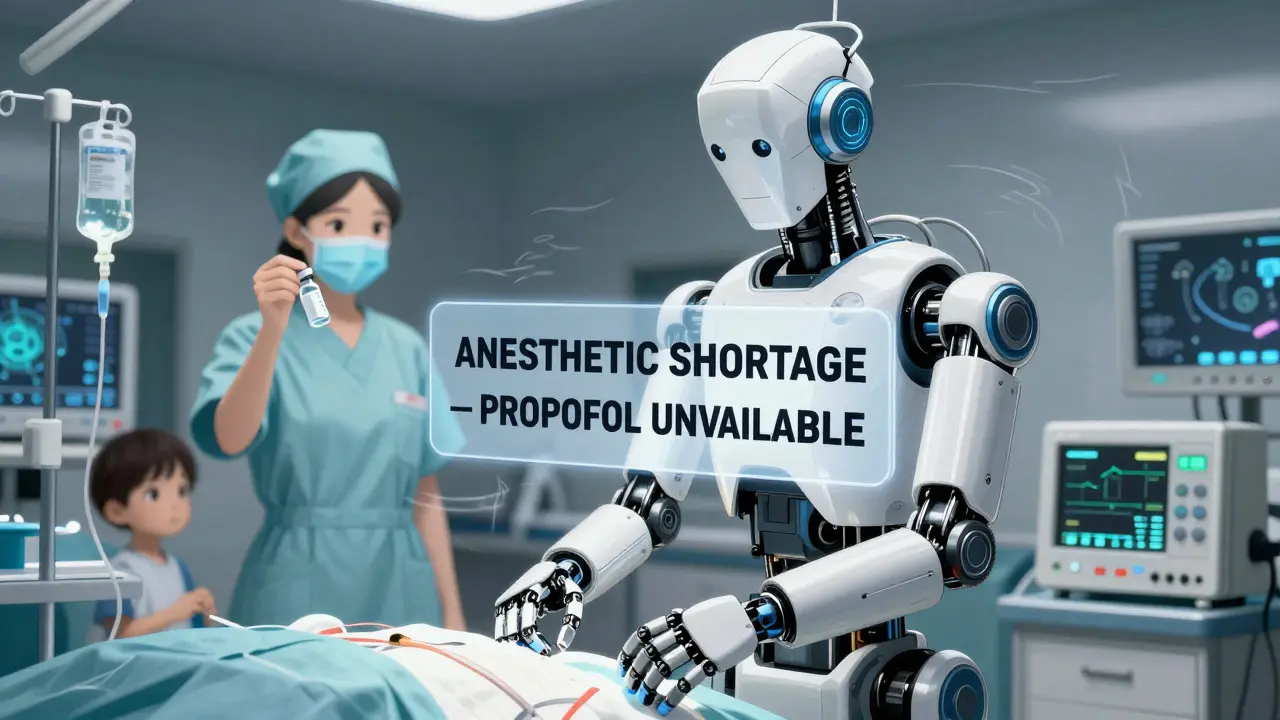
The Human Cost: Pharmacists, Nurses, and Ethical Dilemmas
Behind every shortage is a hospital pharmacist working 11.7 hours a week just to find alternatives. That’s over 500 hours a year spent not on patient counseling, not on checking prescriptions, but on calling distributors, begging for stock, and navigating bureaucratic approval processes to swap one drug for another. The CompleteRx 2025 survey of 350 hospital pharmacy directors found that 92% of staff are overwhelmed by these tasks. And then there’s the moral weight. In a 2025 survey by the American Society of Health-System Pharmacists, 68% of hospital pharmacists said they’ve faced ethical dilemmas during shortages. Over 40% admitted to using less effective alternatives because there was no other choice. One pharmacist on Reddit wrote: “Running out of normal saline for three weeks straight forced us to use oral rehydration for post-op patients-never thought I’d see the day.” That’s not innovation. That’s desperation. Some hospitals have created formal shortage management committees. But only 32% of them feel these teams are properly funded or staffed. The rest are improvising-relying on spreadsheets, WhatsApp groups, and personal contacts. And when protocols aren’t documented, the risk of medication errors rises. The ASHP reports that 31% of hospitals still manage shortages with informal, ad-hoc methods. That’s not just inefficient. It’s dangerous.Why Fixes Keep Failing
You’d think with all the attention, someone would fix this. But the solutions keep falling short. The FDA requires manufacturers to notify them of potential shortages. That sounds good-until you learn that only 14% of those notifications lead to timely resolution. The Consolidated Appropriations Act of 2023 made earlier notifications mandatory, but the Government Accountability Office found it only reduced shortage duration by 7%. The Biden administration pledged $1.2 billion in 2024 to boost domestic manufacturing. That’s a start. But industry analysts say it will take 3 to 5 years before that money translates into more reliable supply. Meanwhile, only 12% of sterile injectable manufacturers have adopted new technologies like continuous manufacturing, which could make production faster and more resilient. The rest are still using 20-year-old equipment, running on thin margins, and hoping nothing breaks. The market is also dangerously concentrated. Just three companies control 65% of the supply for basic IV fluids like sodium chloride and potassium chloride. One plant failure, one recall, one audit-boom. The whole country feels it.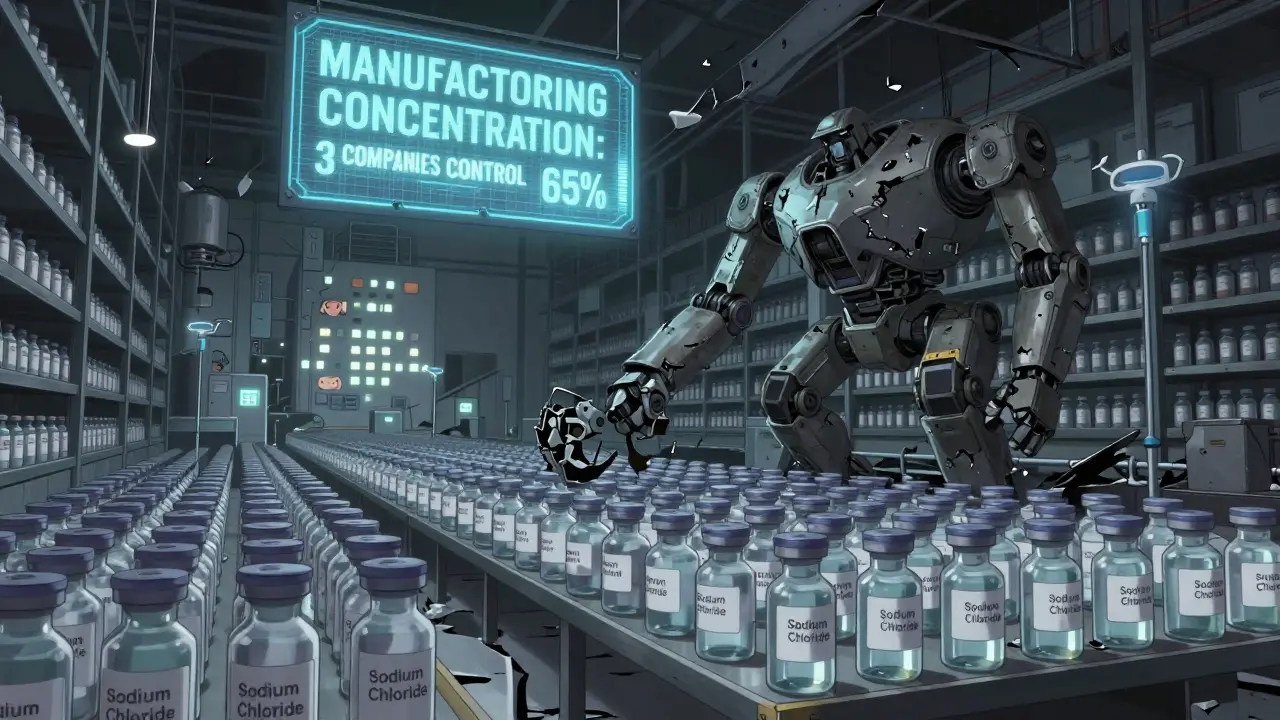
What’s Being Done-And What’s Not
Some hospitals are getting smarter. They’re consolidating stock into central locations. They’re updating standing orders to include approved therapeutic alternatives. They’re building direct relationships with alternative suppliers, even overseas. One hospital in Ohio saved 18% of its critical drug disruptions after implementing a tiered allocation system during the 2024 saline crisis. But these fixes take time. New pharmacy directors take an average of 6.2 months to become proficient in managing shortages. And only 45% of hospitals have written, regularly updated protocols. The FDA’s 2025 Strategic Plan for Drug Shortage Prevention offers incentives for quality improvements-but no penalties for poor performance. The American Medical Association called it “insufficient.” The industry isn’t investing in redundancy because there’s no financial reward. And until that changes, hospitals will keep being the first to feel the pinch.The Road Ahead: No Easy Fixes
The number of active shortages dropped from 270 in April 2025 to 226 in July 2025. That sounds like progress. But the root causes haven’t changed. Manufacturing is still concentrated. Margins are still too low. Quality controls are still inconsistent. Climate events are still disrupting supply chains. And the population is aging-more elderly patients, more complex treatments, more demand for injectables. Hospital pharmacy directors surveyed in late 2024 expect shortages to stay the same or get worse through 2026. Without major policy changes-like guaranteed minimum profit margins for essential sterile injectables, mandatory investment in backup manufacturing, or federal subsidies for quality upgrades-this won’t improve. The system isn’t broken. It was designed this way. And until that design changes, hospitals will keep playing defense, trying to keep patients alive with whatever’s left on the shelf.Why are sterile injectables more prone to shortages than oral medications?
Sterile injectables require complex, aseptic manufacturing in controlled environments, which is far more expensive and technically demanding than making pills or capsules. They also have very low profit margins-often just 3-5%-so manufacturers have little incentive to invest in backup equipment or redundant production lines. Plus, most raw ingredients come from just a few countries, and a single quality issue or natural disaster can shut down production for months.
Which types of injectable drugs are most commonly in shortage?
Anesthetics like propofol and lidocaine have the highest shortage rates at 87%, followed by chemotherapeutics (76%) and cardiovascular drugs like epinephrine and nitroglycerin (68%). IV fluids such as normal saline and lactated Ringer’s solution are also frequently in short supply due to manufacturing concentration and high demand.
How do shortages affect patient care in hospitals?
Shortages lead to delayed surgeries, postponed treatments, and the use of less effective or riskier alternatives. For example, without anesthetics, elective procedures are canceled. Without chemotherapy drugs, cancer patients face treatment delays. Without IV fluids, patients may be given oral rehydration instead-something that doesn’t work for everyone. In some cases, patients have been transferred to other hospitals because their facility ran out of a critical drug.
Are there any alternatives hospitals can use when a drug is unavailable?
Yes, but only if they’re approved by the hospital’s pharmacy and therapeutics committee. Therapeutic substitutions are possible for some drugs-for example, switching from one antibiotic to another with similar effects. But for many injectables, especially anesthetics and chemotherapeutics, there are no safe or effective substitutes. Even when alternatives exist, they may require different dosing, monitoring, or administration methods, which increases workload and risk.
What can be done to prevent future shortages?
Solutions include incentivizing manufacturers to produce essential injectables at higher margins, requiring backup manufacturing capacity, investing in modern production technologies like continuous manufacturing, and reducing reliance on foreign suppliers for active ingredients. Policy changes that mandate stockpiling of critical drugs or offer federal subsidies for quality upgrades could also help. But so far, most efforts have been reactive-not systemic.

Jerian Lewis
It’s disgusting how we let this happen. Companies make billions off life-saving drugs but won’t spend a dime on backup systems because profit margins are too thin. And we wonder why people die waiting for saline. This isn’t an accident-it’s corporate negligence dressed up as ‘market efficiency.’
Gregory Clayton
China and India are running the show and we’re sitting here like idiots? We built the modern world and now we can’t even make IV bags? Bring the factories back. Build ‘em in Texas. Put tariffs on every pill that comes from overseas. This ain’t a supply chain issue-it’s a national security crisis.
And don’t give me that ‘it’s expensive’ crap. We spend $800 billion on defense. Where’s the budget for keeping people alive?
Jeffrey Hu
Let’s be precise here. The 60% statistic for sterile injectable shortages comes from the USP Drug Shortage Database, but it’s misleading because it includes temporary, non-critical disruptions. The real crisis is in high-margin, low-volume injectables-chemotherapeutics, neuromuscular blockers, vasopressors. These aren’t ‘common drugs’-they’re specialized, low-volume products with razor-thin margins and no economies of scale.
Also, 80% of API sourcing from Asia isn’t the root cause-it’s the lack of FDA-qualified backup sites. There are 14 active sterile injectable manufacturers in the U.S. and 3 of them supply 65% of IV fluids. That’s not ‘concentration,’ that’s monoculture. And monocultures collapse.
Continuous manufacturing could fix this, but it requires $200M+ in CAPEX. No private equity firm will fund that unless there’s a guaranteed margin floor. Which brings us to the real problem: no one’s willing to pay for reliability.
Meghan Hammack
My cousin’s a nurse in Chicago. She told me last week they ran out of epinephrine for 3 days. Three days. And they had to use a syringe from a 1998 batch that was stored in a fridge labeled ‘DO NOT USE.’
They didn’t tell the families. They just did what they had to. I cried for an hour after she told me.
These aren’t numbers. These are people. And the people who fix this? They’re the pharmacists working 12-hour days just to find a vial. We need to honor them. Not just tweet about it. ACT.
PLEASE. Someone. Do something.
RAJAT KD
India produces 40% of global generic injectables. Quality control is not a Western problem-it is a global supply chain failure. Indian regulators lack resources. U.S. FDA inspections are delayed by 18 months. Both sides are failing. No blame game. Just fix the system.
Also, 76% of chemotherapeutics shortage? That’s criminal. Cancer patients are dying because of bureaucratic inertia.
Matthew Maxwell
It is profoundly irresponsible to suggest that market forces alone can be relied upon to ensure the availability of life-sustaining pharmaceuticals. The absence of a mandatory profit margin floor for essential sterile injectables constitutes a systemic failure of public policy. The FDA’s voluntary notification regime is a charade. The Consolidated Appropriations Act of 2023 was toothless. The $1.2 billion federal investment, while well-intentioned, is statistically insignificant relative to the scale of the problem.
Until Congress mandates minimum inventory buffers, requires redundancy in manufacturing, and enforces penalties for non-compliance with supply continuity protocols, this crisis will persist. This is not a matter of opinion. It is a matter of moral and legal obligation.
Lindsey Wellmann
Okay but like… imagine being a pharmacist and having to tell a mom her kid’s caffeine citrate is gone so you’re giving them a teaspoon of sugar water? 😭
And then the hospital sends out a Slack message saying ‘we’re using oral rehydration for post-op patients’ like it’s a cool hack??
THIS IS NOT A HACK. THIS IS A NIGHTMARE.
Someone please fix this. I’m not even a doctor and I’m crying. 💔💉
Ian Long
I get why people are angry. But yelling at China or blaming ‘greedy pharma’ doesn’t fix the machines that broke or the inspectors who are understaffed.
We need collaboration-not blame. Hospitals, regulators, manufacturers, even competitors-they all need to share data on inventory and bottlenecks. Some hospitals are already doing it with encrypted dashboards. That’s the future.
And yeah, we need policy. But policy alone won’t work if the people on the ground don’t have the tools to adapt. Let’s fund the pharmacists who are holding this together. Train them. Pay them. Listen to them. They’re the real heroes here.
Let’s stop treating this like a political football and start treating it like a public health emergency.