
More than 9 in 10 prescriptions filled in the U.S. are for generic drugs. Yet, many clinicians still hesitate to prescribe them - not because patients refuse, but because clinician education on generics is inconsistent, incomplete, or missing entirely.
It’s not that doctors don’t want to save money. It’s that they’re unsure. Is the generic really the same? Could the inactive ingredients cause problems? Why does my patient say the brand version "works better"? These aren’t just patient myths - they’re symptoms of a deeper gap in training.
Why Provider Education on Generics Matters
Generic drugs aren’t cheaper because they’re lower quality. They’re cheaper because they don’t need to repeat expensive clinical trials. The FDA requires them to have the same active ingredient, strength, dosage form, and route of administration as the brand-name drug. Bioequivalence is proven through strict testing: the 90% confidence interval for absorption (AUC) and peak concentration (Cmax) must fall between 80% and 125% of the brand drug’s levels. That’s not a guess - it’s science.
But here’s the problem: a 2020 survey found that 27% of prescribers wrongly believed generics could contain up to 25% less active ingredient. Another 45% thought inactive ingredients had to be identical. Both are false. Inactive ingredients can differ - as long as they don’t affect safety or effectiveness. That’s why the FDA’s Orange Book lists therapeutic equivalence ratings: "A" means interchangeable, "B" means not equivalent.
When clinicians misunderstand this, patients pay the price. Studies show patients are 35% more likely to start a medication if it’s generic. But if the doctor hesitates - even subtly - patients pick up on it. A Harvard study found that when providers explicitly endorsed generic equivalence, patient-reported side effects dropped by 18%. That’s not placebo. That’s nocebo: the expectation of harm causing real symptoms.
What Clinicians Get Wrong About Generics
Let’s clear up the biggest myths.
Myth 1: Generics are made in worse factories. The FDA inspects generic manufacturing sites just as rigorously as brand-name ones. In fact, many brand-name companies make their own generics. The same plants. Same equipment. Same quality controls.
Myth 2: Bioequivalence means "close enough." It doesn’t. The 80-125% range isn’t a loophole. It’s a tight window. If a drug’s absorption varies by more than 25%, it fails. That’s stricter than most people realize. For drugs with narrow therapeutic windows - like warfarin or levothyroxine - the FDA applies even more scrutiny. And yet, some doctors still avoid generics for these conditions.
Myth 3: Patients always prefer brand names. Not true. Patients care about cost. When a $300 brand-name drug is replaced with a $4 generic, most patients are relieved - if their doctor explains why it’s safe. But if the doctor says, "I’m not sure about this one," that’s all the patient needs to hear.
A 2021 JAMA Internal Medicine study showed that clinicians who received interactive, case-based education retained 42% more knowledge six months later than those who just read a handout. Real learning sticks. Passive info doesn’t.
Where Education Falls Short - And How to Fix It
Medical schools teach generic names. But in clinics, attending physicians still say "Lopressor," not "metoprolol." Residents hear brand names in rounds, see them on charts, and learn to repeat them. It’s not malice - it’s habit.
One resident on Reddit wrote: "I nearly prescribed two doses of metoprolol because my attending said 'Lopressor twice daily' without specifying it was the same as the generic I'd just ordered."
That’s not an isolated story. A 2022 poll of 4,200 physicians on Sermo showed 63% wanted more continuing education on generic equivalence. Internal medicine specialists - who manage the most chronic conditions - were the most eager, at 78%.
The fix? Education must be embedded, not appended. Here’s what works:
- **EHR alerts**: When a prescriber types "Lipitor," the system auto-suggests "atorvastatin" with a link to FDA equivalence data.
- **Case-based modules**: Instead of a 30-minute webinar, use real patient scenarios: "A 68-year-old with hypertension can’t afford $120/month. What do you do?"
- **Pharmacist collaboration**: Pharmacists can flag high-cost prescriptions and offer to consult with the prescriber. In one study, this increased generic prescribing by 15.7 percentage points.
- **CME credits tied to real outcomes**: If a provider completes a module on generic use and their generic prescribing rate increases by 10%, they earn credit. No more checkbox learning.
The University of California San Francisco cut brand-name statin prescriptions by 37% in one year using this approach. It wasn’t a mandate. It was better education.
Special Cases: Psych, Cardio, and Chronic Disease
Some conditions need extra care.
Psychiatric medications are a prime example. Patients often believe generics "don’t work as well" for depression or anxiety. But studies show no difference in efficacy. The problem? Nocebo. If a patient thinks the generic will fail, they’re more likely to report side effects - or stop taking it. Provider endorsement is the single strongest predictor of adherence. One study found patients were 3.2 times more likely to stick with treatment when their doctor said, "This generic is identical to the brand."
Cardiovascular drugs like beta-blockers and statins are another area where cost matters. A $100 monthly brand-name drug becomes $4 as a generic. But cardiologists are among the most resistant - 82% express hesitation, according to pharmacist surveys. Why? Some believe small differences in absorption matter for heart conditions. But the data doesn’t support that. The FDA’s bioequivalence standards are designed precisely for drugs where consistency matters most.
Chronic disease management - diabetes, hypertension, asthma - is where generics make the biggest difference. Patients who can’t afford their meds won’t refill. A 2020 ASPE brief showed that switching to generics improved adherence by 12-15% in low-income populations. That’s not just cost savings. That’s fewer ER visits. Fewer hospitalizations. Longer life.

The Future: AI, VR, and Value-Based Care
Education is evolving.
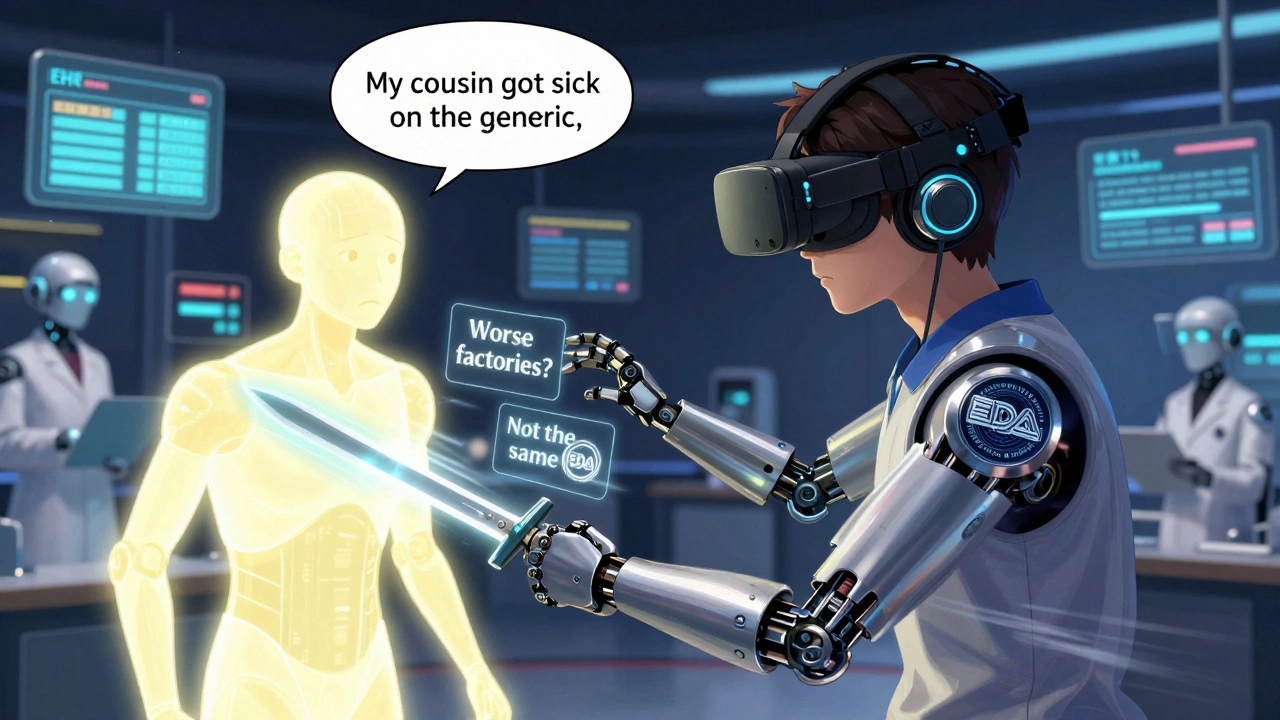
The FDA launched a virtual reality training tool in 2023 that simulates patient conversations about generics. Clinicians practice responding to concerns like, "My cousin took the generic and got sick." Early results show a 41% boost in communication confidence.
UnitedHealthcare’s 2024 pilot used AI to identify doctors with low generic prescribing rates. It then delivered personalized educational nudges - a short video, a case study, a reminder about cost savings. The result? A 28% increase in generic prescriptions in just six months.
And in 2025, CMS will start measuring generic prescribing rates as part of the Merit-based Incentive Payment System (MIPS). Providers who consistently choose generics will earn higher reimbursement. Those who don’t? They’ll lose money.
This isn’t punishment. It’s alignment. When financial incentives match clinical outcomes, behavior changes.
Getting Started Today
You don’t need a big program. Start small.
- **Use the FDA’s Generic Drug Facts Handout**. It’s free, clear, and approved by regulators. Print it. Keep it on your desk.
- **Say the generic name first**. Instead of "I’m prescribing Lipitor," say "I’m prescribing atorvastatin - the generic version of Lipitor. It’s the same medicine, and it costs $4."
- **Ask patients**: "Have you taken this medication before? Were you happy with it?" Listen. Then correct myths with facts.
- **Talk to your pharmacist**. They know what’s available, what’s covered, and what patients are saying. Make them part of your team.
There’s no magic bullet. But there’s a simple truth: when clinicians understand generics, patients get better care - and pay less. That’s not just good economics. It’s good medicine.
Are generic drugs really as effective as brand-name drugs?
Yes. The FDA requires generic drugs to have the same active ingredient, strength, dosage form, and route of administration as the brand-name version. They must also meet strict bioequivalence standards - meaning they’re absorbed into the body at the same rate and extent as the brand. Over 90% of prescriptions in the U.S. are for generics, and studies show no difference in clinical outcomes for most conditions.
Why do some doctors still prefer prescribing brand-name drugs?
Many doctors were trained to use brand names, and habits are hard to break. Others worry about patient concerns or misunderstand bioequivalence standards. Some believe inactive ingredients or manufacturing differences affect outcomes - even though the FDA has shown they don’t. Lack of education and time pressure in clinics also play a role. But when doctors receive targeted, interactive training, their confidence and prescribing rates for generics rise significantly.
Can pharmacists substitute generics without the doctor’s permission?
It depends on the state. Thirty-four states allow pharmacists to substitute a generic drug without contacting the prescriber, as long as it’s listed as therapeutically equivalent in the FDA’s Orange Book. Sixteen states require the prescriber to write "dispense as written" on the prescription to prevent substitution. Always check your state’s laws, but remember - if the drug is rated "A" in the Orange Book, substitution is safe and legal in most places.
Are biosimilars the same as generics?
No. Generics are exact copies of small-molecule drugs, like metoprolol or atorvastatin. Biosimilars are highly similar versions of complex biological drugs, like insulin or Humira. They’re not identical because biologics are made from living cells, not chemicals. The FDA has separate approval pathways for each. Only 31% of providers can correctly explain the difference, which is why education is critical - especially in oncology and rheumatology.
How can I learn more about generic drug equivalence?
Start with the FDA’s free resources: the Generic Drug Facts Handout and the Generic Drugs and Health Equity Handout. Both are available on the FDA’s website. Also consider the Generic Pharmaceutical Association’s (GPhA) educational modules, or enroll in a CME course focused on therapeutic equivalence. Many academic medical centers now include this in residency training. If your clinic doesn’t offer it, ask for it.

Declan O Reilly
Man, I’ve seen so many docs still say "Lopressor" like it’s 1998. I get it-habits stick. But when your patient’s insulin costs $400 and the generic’s $12, you’re not being a doctor, you’re being a relic. The science’s been settled for decades. It’s not about trust in the drug-it’s trust in your own education.
Conor Forde
Ohhh here we go again. The FDA’s got a magic wand, right? Tell that to the guy who switched from Brand X to generic and started hallucinating. Coincidence? Or did the fillers in the generic turn his brain into a disco ball? 🤔
patrick sui
Great post. The bioequivalence range (80-125%) is often misunderstood-it’s not "close enough," it’s statistically rigorous. But here’s the real issue: most med schools don’t teach therapeutic equivalence as a clinical skill. It’s buried in pharmacokinetics lectures. We need case-based learning, like the JAMA study showed. And pharmacists? They’re the unsung heroes here. Let’s integrate them into rounds. 🤝
Michelle Smyth
How quaint. You assume clinicians are just poorly educated. What if they’ve seen patients crash after switching? What if the "science" is funded by Big Generic? The FDA’s Orange Book is a corporate brochure, not a gospel. And don’t get me started on how they approve generics from factories with zero oversight.
Linda Migdal
Generic drugs? Made in China. How is that even legal? We’re letting foreign labs control our medicine supply. If your heart’s beating, you’re trusting a factory in Guangdong that doesn’t even speak English. This isn’t healthcare-it’s a national security risk.
Tommy Walton
Bro, I switched my anxiety med to generic. Felt like a robot for 3 weeks. 🤖 No cap. The docs are lying. It’s not the same. Period.
James Steele
Let’s not conflate bioequivalence with clinical equivalence. The FDA’s standards are adequate for pharmacokinetics, but they ignore interindividual variability, gut microbiome interactions, and epigenetic modulation of drug response. This is reductive pharmacology masquerading as evidence-based practice. The data may be statistically sound-but clinically, it’s a gamble.
Louise Girvan
EVERYONE knows generics cause more side effects. The FDA lets them use "inactive" ingredients that are literally poison. Aspartame. Dyes. Corn starch. Your "equivalent" pill has more fillers than your grandma’s pie. And they wonder why people are sick? It’s not placebo-it’s poison.
soorya Raju
Generic drugs? HA! They’re just rebranded Chinese factory rejects. I know a guy in Mumbai who worked in one-they dump the bad batches into generics and ship them to the US. The FDA? Paid off. Doctors? Brainwashed. You think your blood pressure med is safe? Nah. It’s a lottery ticket.
Dennis Jesuyon Balogun
As a clinician in Lagos, I’ve seen patients die because they couldn’t afford brand drugs. Generics saved lives here-literally. But I also know the fear. When you’re working with no lab support, no follow-up, and no trust in the supply chain, hesitation is survival. Education isn’t enough. We need infrastructure. We need reliable distribution. We need the FDA to audit factories in Nigeria too-not just in China. This isn’t just about knowledge. It’s about justice.
Grant Hurley
Been prescribing generics for 12 years. My patients are healthier, refill more, and don’t skip doses. No magic. Just honesty. I say: "This is the same pill, costs less, and your body won’t know the difference." Simple. Works. Also, I’m not a robot-I still say "Lipitor" sometimes. Old habits die hard. But I’m trying.
Lucinda Bresnehan
I’m a pharmacist in rural Ohio. I see this every day. An elderly woman comes in for her statin-$140 for Lipitor, $4 for atorvastatin. She says, "My doctor said I shouldn’t switch." I pull up the FDA’s equivalence chart, show her the identical active ingredient, and explain the fillers are harmless. She cries. Not from sadness-from relief. That’s the moment you realize: it’s not about the science. It’s about the story you tell.
Shannon Gabrielle
Wow. So the solution to doctor ignorance is... more education? Groundbreaking. Next you’ll tell us vaccines are safe and climate change is real. Meanwhile, the real problem is that doctors are overworked, underpaid, and forced to prescribe what the insurance company pushes. Blame the system, not the clinician who’s just trying not to get sued.
ANN JACOBS
It is of paramount importance, and indeed, a matter of profound clinical and ethical significance, that the prescriber’s understanding of generic pharmaceutical equivalence be not merely superficial, but deeply rooted in a comprehensive, evidence-based, and systematically reinforced educational framework that transcends the limitations of traditional didactic instruction and embraces experiential, longitudinal, and interprofessional pedagogical modalities-thereby ensuring that therapeutic decision-making is not compromised by outdated heuristics or cognitive biases rooted in institutional inertia. The integration of EHR-based decision support, pharmacist-led clinical collaboration, and value-aligned incentive structures represents not merely an improvement, but a paradigmatic evolution in the delivery of equitable, cost-conscious, and scientifically rigorous patient care.