
Risk Benefit Calculator
Understand Your Risk
How does this work?
Your doctor says: "This drug reduces your risk by 50%."
What does that mean for YOU? Enter your current risk to see the real numbers.
Your Risk Comparison
What this means for you:
Enter your risk and reduction percentage to see your actual benefit.
Why FDA Drug Labels Feel Like a Puzzle
Ever read the fine print on a new prescription and felt like you needed a degree to understand it? You're not alone. FDA-approved drug labels are packed with critical information about how a medicine works, what side effects it might cause, and whether those side effects are worth the benefit. But for most patients, these labels are written in dense medical language that doesn’t connect with real life. The FDA knows this. And over the last few years, they’ve been trying to fix it.
The goal isn’t just to list risks and benefits. It’s to help you decide - with your doctor - whether a drug makes sense for you. That’s harder than it sounds. A drug might reduce your chance of a heart attack by 38%, but if you’re 80 and have other health problems, does that number even matter? The FDA’s job is to look at data from thousands of people. But your decision is personal.
What’s Actually in an FDA Label?
FDA drug labels aren’t random documents. They follow strict rules under 21 CFR 314.50(c)(5)(viii), which says every new drug must include an integrated summary of its benefits and risks. This isn’t buried in the back. It’s in the Highlights section - the part your doctor is supposed to read with you.
Here’s where you’ll find the key pieces:
- Section 5 (Contraindications): When NOT to take the drug. For example, if you have severe liver disease, this drug could kill you.
- Section 6 (Adverse Reactions): Side effects you might get. Some are common (nausea, dizziness). Others are rare but serious (liver failure, suicidal thoughts).
- Section 8 (Use in Specific Populations): Is it safe for pregnant women? Kids? Seniors? This section tells you who the data doesn’t cover well.
- Section 14 (Clinical Studies): The raw numbers. How many people got better? How many had bad reactions? This is where the real story lives.
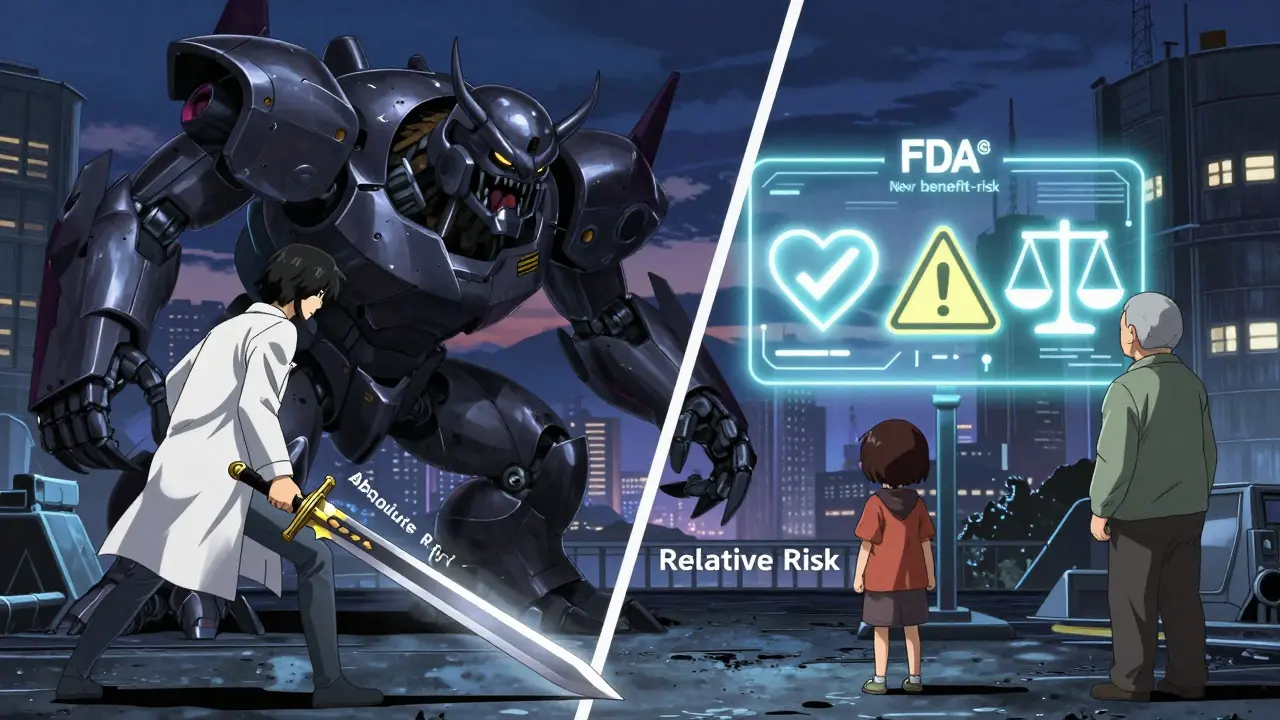
But here’s the problem: most labels don’t tell you how these numbers compare to other options. They say, “This drug reduces stroke risk by 25%.” But 25% of what? If your baseline risk is 2%, that’s a drop to 1.5%. If your risk is 20%, that’s a drop to 15%. The difference matters - but it’s rarely explained.
The FDA’s Benefit-Risk Framework: A Behind-the-Scenes Look
Inside the FDA, reviewers use a tool called the Benefit-Risk Framework (BRF), introduced in December 2021. It’s not meant for patients. It’s for scientists and regulators. But it shapes what ends up in your label.
The framework asks four big questions:
- What’s the severity of the condition? (Is this a life-threatening disease or a mild annoyance?)
- What treatments already exist? (Is this drug better than what’s already on the shelf?)
- What are the proven benefits? (Survival? Pain relief? Lower hospital visits?)
- What are the real risks? (How often do bad things happen? Are they reversible?)
For cancer drugs, this works well. A drug that extends life by 4 months with manageable side effects? That’s a win. But for antidepressants? It’s messy. How do you measure “feeling better”? And what’s the risk of weight gain, sexual dysfunction, or increased suicidal thoughts in young adults? These aren’t easy numbers to compare.
The FDA admits this. In their own guidance, they say: “There may be a tension between the population-level assessment and the individual patient’s values.” Translation: What’s right for most people might not be right for you.
Why You’re Still Confused - And What’s Being Done
Despite all the effort, most patients still don’t understand their labels. A 2022 survey by the National Health Council found only 22% of patients felt “very confident” in reading them. For those with low health literacy, that number dropped to 9%.
Why? Three big reasons:
- Relative vs. Absolute Risk: Labels often say “reduces risk by 50%.” Sounds great - until you learn that means going from 2% to 1%. That’s not a 50% improvement in your daily life. It’s a 1% absolute change.
- No Comparison: The label tells you how the drug performs against a placebo. But you’re not comparing it to sugar pills. You’re comparing it to other drugs, lifestyle changes, or doing nothing. That context is missing.
- No Visuals: Numbers on paper are hard to grasp. A graph showing “for every 100 people taking this drug, 3 will avoid a heart attack, but 2 will have a serious bleed” is way clearer than a paragraph of percentages.
The FDA is starting to fix this. In September 2023, they launched a pilot program requiring six new cancer drugs to include a “Patient Benefit-Risk Summary” in their labels - written at a 6th-grade reading level and using simple visuals. Early results show patients understand the trade-offs 40% better than with traditional labels.
They’re also testing “Benefit-Risk Icons” - tiny pictograms developed with the National Institutes of Health. One icon might show a heart with a checkmark and a warning sign next to it, representing benefit versus risk. No words needed.
Real-World Examples: What Works
Not every label is confusing. Some companies are getting it right.
Take Jardiance (empagliflozin), a diabetes drug. Its label says: “In adults with type 2 diabetes and cardiovascular disease, JARDIANCE reduced the risk of cardiovascular death by 38% (10.5% with placebo vs. 6.5% with JARDIANCE).”
That’s clear. It tells you:
- Who it helps: people with diabetes and heart disease
- What the benefit is: fewer deaths from heart problems
- How big it is: 38% reduction
- What the numbers really mean: 10.5 out of 100 died on placebo; 6.5 out of 100 died on Jardiance
That’s the gold standard. No jargon. No fluff. Just facts you can use.
Compare that to a label for a new anxiety medication that says: “May be associated with increased risk of suicidal ideation in adolescents.” That’s vague. How many? When? Compared to what? That’s not helpful. That’s scary.

What You Can Do Right Now
You don’t have to wait for the FDA to fix everything. Here’s how to read your label like a pro:
- Find the Highlights section. It’s usually the first few pages. That’s where the FDA’s official summary lives.
- Look for absolute numbers. Ask: “What’s the actual chance of this benefit or risk happening?” If it only says “reduced risk by X%,” ask your doctor what that means for you.
- Compare to alternatives. “Is this better than the drug I’m on? Or cheaper? Or safer?” Your doctor should be able to tell you.
- Ask for a visual. “Do you have a chart or diagram showing how this drug compares to others?” Most doctors have access to tools like the FDA’s Drug Facts or MedlinePlus summaries.
- Check the date. Labels get updated. Make sure you’re reading the latest version.
Don’t be afraid to say: “I don’t understand this. Can you explain it in plain terms?” That’s your right.
The Bigger Picture: Why This Matters
This isn’t just about reading labels. It’s about trust. When patients feel like they can’t understand the risks and benefits of their medicine, they stop taking it. Or they take it too long. Or they avoid it altogether - even when it could save their life.
The FDA’s push for clearer communication isn’t just bureaucracy. It’s a response to real patient pain. In 2021, over 78% of patients who gave feedback to the FDA said they wanted clearer comparisons to other treatments. That’s not a small number. That’s a demand.
And the industry is listening. Sixty-eight percent of top pharmaceutical companies now hire “patient communication specialists” - a job that didn’t exist a decade ago. They’re rewriting labels, designing icons, and training sales reps to talk to patients - not just doctors.
By 2026, nearly half of all new drug labels are expected to include visual benefit-risk summaries. That’s a huge shift. And it’s happening because patients spoke up.
What’s Next?
The FDA plans to require patient-friendly summaries for all breakthrough therapies by 2025. They’re working on standardized benefit-risk metrics - so a diabetes drug’s benefit can be compared fairly to a heart drug’s benefit. That’s still a work in progress. But it’s coming.
For now, the best tool you have is your doctor. Use your label as a conversation starter. Don’t just accept the words on the page. Ask questions. Push for clarity. And remember: your health isn’t a statistic. It’s your life. You deserve to understand what you’re putting into it.

phara don
I always skim the label and just trust my doctor... but after reading this, I'm gonna actually read the Highlights section now. That 38% reduction example? Mind blown. 🤯
Hannah Gliane
Oh wow, so the FDA finally realized people aren't medical robots? Took them long enough. I've been screaming about this since my grandma nearly died from a label that said 'may cause dizziness' and didn't mention it also makes you hallucinate spiders. 🙄
Murarikar Satishwar
The clarity of Jardiance’s label is a benchmark. In India, we often get labels translated from English without cultural or linguistic adaptation. The absolute risk numbers, visual icons, and plain language approach should be global standards. This isn't just patient empowerment-it's public health equity.
Dan Pearson
You think this is bad? Try getting a label in the UK. They make it sound like the drug is gonna turn you into a zombie. Meanwhile, we’re giving out pills like candy here and calling it 'personalized medicine.' America still leads, folks. 🇺🇸
Bob Hynes
I live in Canada and honestly? We get the same labels but with extra footnotes about how 'this may not be covered by your provincial plan.' Like, thanks for the context, but I just wanna know if I'm gonna feel like a corpse or a superhero after taking this. Also, can we get emojis on labels? A skull for 'deadly risk' and a rainbow for 'you'll feel awesome'? 🌈💀
Akhona Myeki
I am a medical professional from South Africa and I find it astonishing that patients are still being subjected to such opaque communication. The FDA's framework is a step, but in resource-limited settings, even a 6th-grade label is a luxury. We need multilingual, audio, and pictogram-based tools-fast.
Sandeep Kumar
All this talk about risk and benefit and visuals... bro just tell me if it'll make me feel better or kill me. Why do we need a whole essay? Just say: 'Take it if you wanna live longer. Don't if you hate nausea.' Done.
Gary Mitts
My grandma took her blood pressure med for 10 years because the label said 'may cause dizziness' and she thought that meant 'might get a little woozy.' Turns out it meant 'you might fall and break your hip.' She didn't ask. Nobody explained. This needs to be mandatory. Period.
clarissa sulio
I work in a pharmacy and people read the label like it's a novel. They panic over 'rare side effect' and quit the med. Then they show up two weeks later with a stroke. We need the icons. Now.
Anthony Massirman
I love that they're testing icons. My buddy in Vancouver used one of those picto-labels on his cholesterol med and he actually remembered to take it. That’s huge. We need this on every pill bottle. Simple. Visual. Universal.
Solomon Ahonsi
Ugh. More bureaucracy. Why can't we just let doctors talk? The FDA's just making more paperwork so they look like they're doing something. Meanwhile, my cousin's still on a drug that gives her night sweats because the label said 'occasional' and she thought that meant 'once a month.'
George Firican
There's a deeper philosophical tension here: medicine as a statistical science versus medicine as a deeply human, subjective experience. The FDA's framework tries to bridge that gap with metrics, but how do you quantify the weight of a mother's fear? Or the dignity of a man who doesn't want to lose his libido to save his heart? Numbers don't hold hands. People do. Maybe the real innovation isn't in the icons, but in the silence between the words-the space where a doctor looks you in the eye and says, 'I'm sorry this is hard, but I'm here.'
Matt W
This is the kind of stuff that actually saves lives. I had a friend who skipped her antidepressant because the label said 'suicidal thoughts possible'-no context, no numbers, just fear. She didn't know the risk was 2 in 1000. If they'd shown her that with a simple graphic? She'd still be here. This isn't just about labels. It's about love.