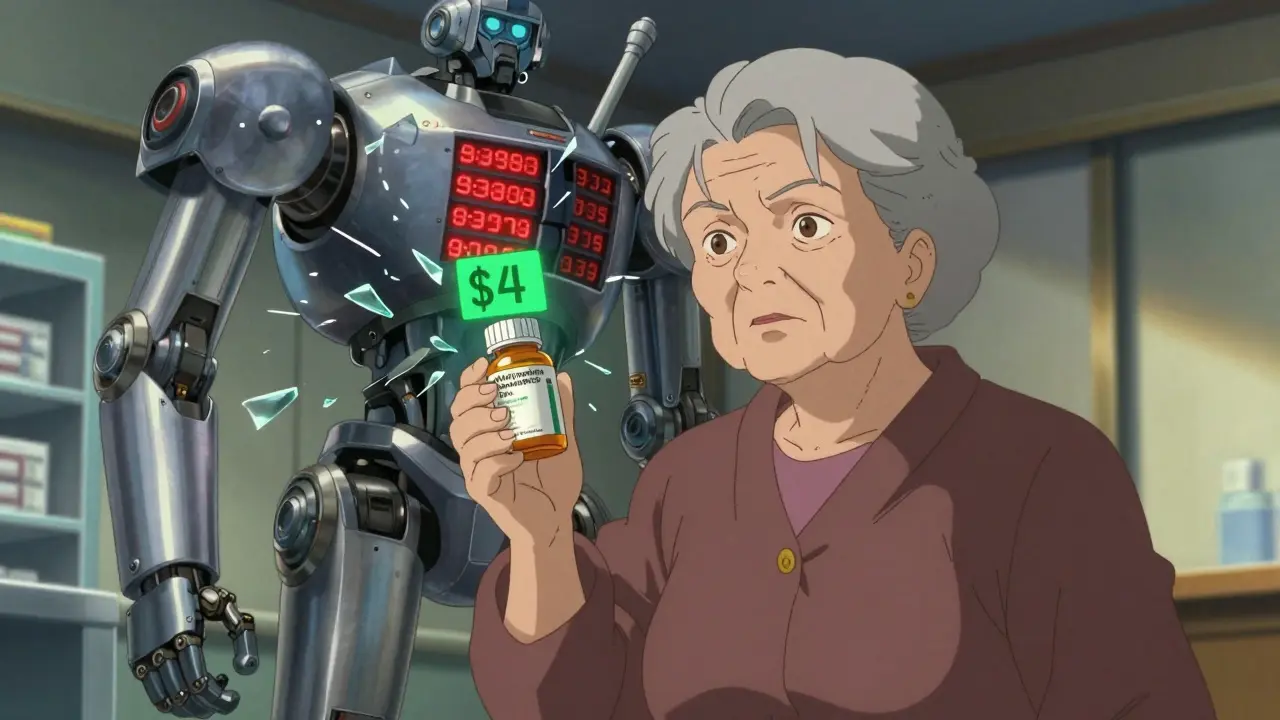
Running out of medication because you can’t afford it isn’t just stressful-it’s dangerous. Millions of people in the U.S. skip doses, split pills, or go without prescriptions each year because of how much drugs cost. The good news? There are real ways to cut those costs, and they don’t always involve insurance. Medication costs are shaped by a mix of corporate pricing, government rules, pharmacy practices, and your own choices. Understanding how coupons, generics, and prior authorizations work can save you hundreds-or even thousands-of dollars a year.
How Generic Drugs Can Cut Your Bill in Half
Generic drugs are chemically identical to brand-name versions, but they cost far less. That’s not marketing hype-it’s science. The FDA requires generics to have the same active ingredient, dosage, strength, and route of administration as the original. The only differences? The color, shape, or inactive fillers. And because generic manufacturers don’t spend millions on advertising or clinical trials, they can sell at a fraction of the price.
Take metformin, for example. The brand-name version, Glucophage, can cost over $100 for a 30-day supply. The generic? Around $4 at most pharmacies. Same drug. Same results. Same safety profile. Yet many people still ask for the brand, thinking it’s better. It’s not.
According to the Congressional Budget Office, generics save Americans more than $200 billion annually. That’s billions in your pocket if you’re switching wisely. Ask your doctor or pharmacist: "Is there a generic version of this?" If they say no, ask why. Sometimes it’s because the brand is new (under patent), but often it’s just habit.
Some drugs don’t have generics yet-especially newer biologics like Humira or Enbrel. But even then, biosimilars are starting to appear. These are highly similar versions of biologic drugs, approved after the original patent expires. In 2025, biosimilars for Humira became widely available, cutting the price from over $7,000 per month to under $2,000 in many cases. That’s an 80% drop. Don’t assume you’re stuck with the expensive option.
Prescription Coupons: What They Really Do (and Don’t Do)
You’ve seen them: "Save $50 on your next prescription!" or "$0 copay for 30 days!" These coupons look like magic. But they’re not always what they seem.
Most manufacturer coupons are designed to help you pay the list price of a drug-not what your insurance actually pays. That means if your insurance already covers the drug at a low rate, the coupon might not help at all. Worse, some insurers won’t let you use a coupon if you’re on Medicare or Medicaid. And if you’re using a coupon on a brand-name drug with a generic available, you’re paying more than you need to.
Here’s how to use them right:
- Use coupons only if you’re uninsured or your plan doesn’t cover the drug.
- Check if the coupon applies to your specific pharmacy. Some only work at CVS or Walgreens.
- Never use a coupon on a drug that has a cheaper generic. You’re overpaying.
- Compare prices using GoodRx or SingleCare before applying a coupon. Sometimes the cash price without a coupon is lower.
Mark Cuban’s Cost-Plus Drugs Company proved something important: when you remove middlemen and markups, you can get branded drugs at 10% off and generics at 30% off. Their model is simple: cost of the drug + $5 pharmacy fee. No spreads, no rebates, no hidden fees. That’s what a transparent system looks like. Coupons don’t fix that-but they can help in the short term.
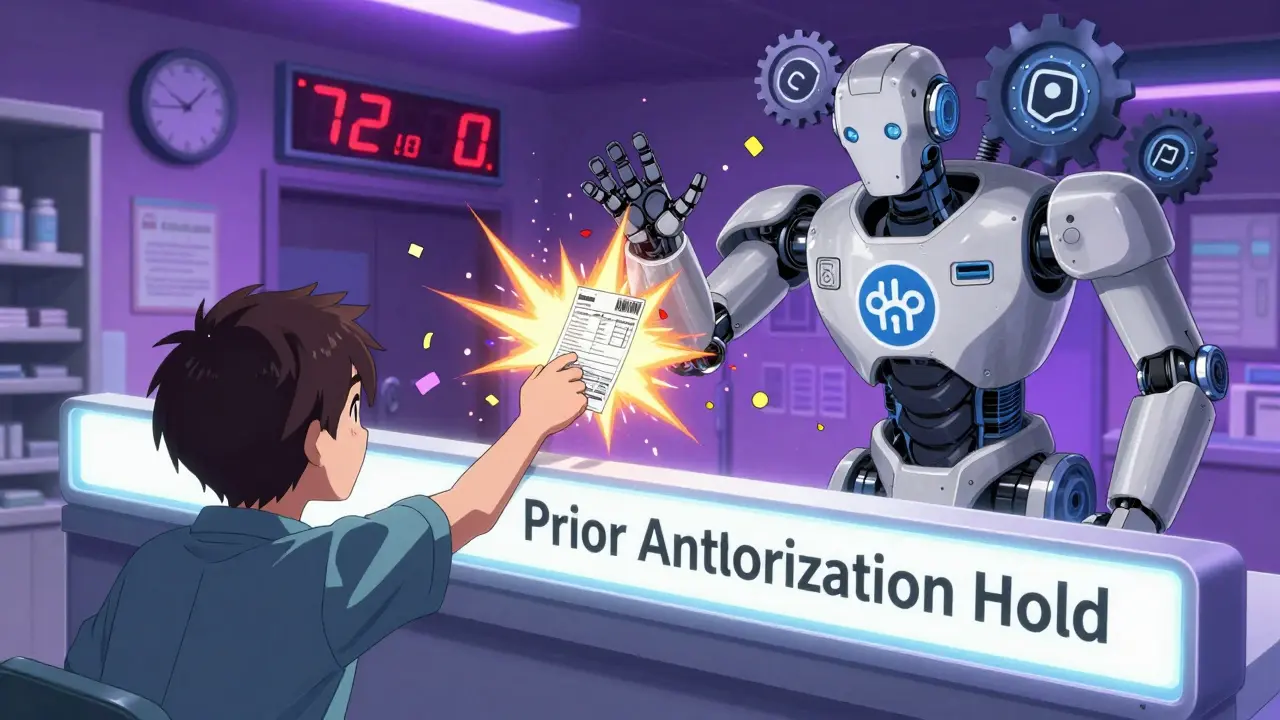
Prior Authorization: The Hidden Bureaucracy That Delays Care
Prior authorization is when your insurance company says, "Wait. We need to approve this drug before you get it." Sounds harmless, right? Except it often takes days-or weeks-to get approved. And during that time, you’re not getting your medication.
Insurance companies use prior authorization to control costs. They’ll require you to try cheaper alternatives first, even if your doctor says they won’t work. For example, if you need a specific diabetes drug, your insurer might force you to try three cheaper ones before approving the one your doctor prescribed. That’s called "step therapy." It’s not about safety-it’s about saving money for the insurer.
Here’s what you can do:
- Ask your doctor to file the prior authorization request immediately after writing the prescription.
- Call your pharmacy to check the status. Many don’t follow up unless you remind them.
- Request a "fast track" if your condition is urgent. Many insurers have emergency exceptions.
- If denied, appeal. You have the right to do so. Your doctor’s letter of medical necessity is your strongest tool.
In 2025, the Centers for Medicare & Medicaid Services (CMS) introduced new rules to cut down on delays. Insurers must now respond to prior authorization requests within 72 hours for non-urgent cases and within 24 hours for urgent ones. Still, many patients report waiting longer. Don’t accept silence. Keep pushing.
How Medicare’s New Rules Are Changing the Game
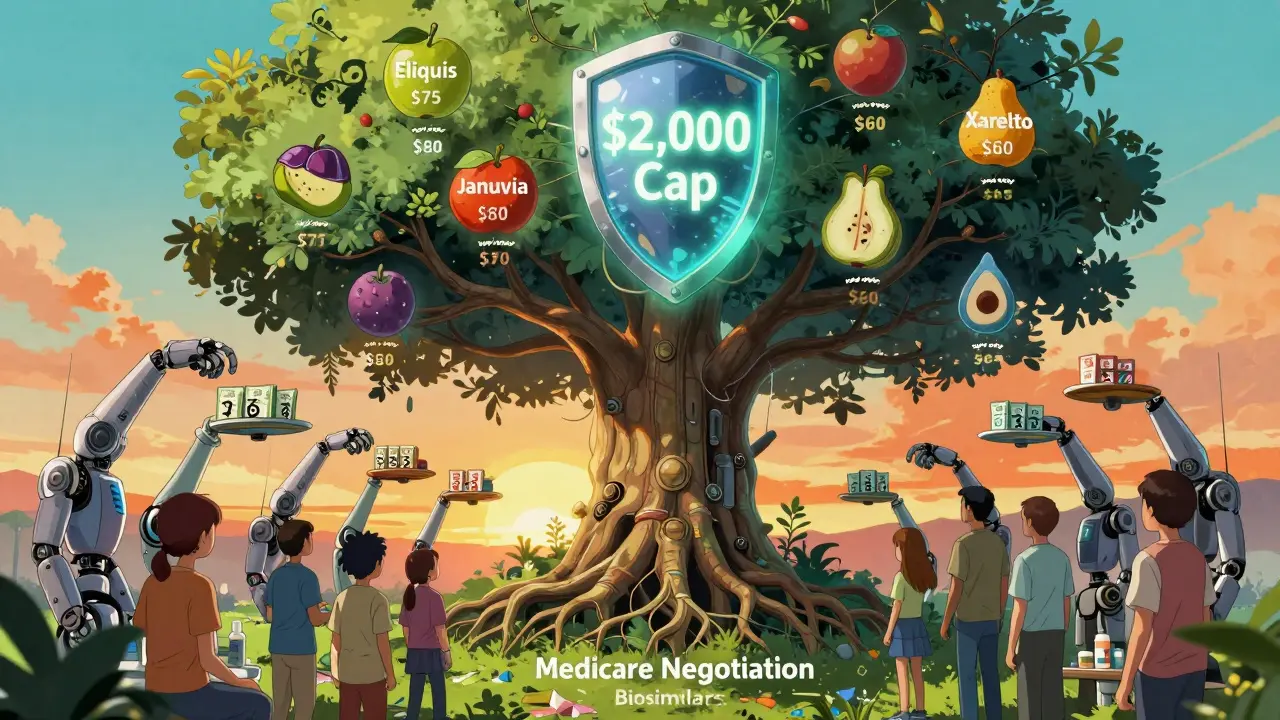
Starting January 2026, Medicare Part D will have major changes that directly affect out-of-pocket costs. The biggest? A $2,000 annual cap on what you pay for prescriptions. That means even if your drugs cost $10,000 a year, you’ll never pay more than $2,000. That’s a huge win for the 19 million Medicare beneficiaries who spend hundreds or thousands on meds each year.
Also new: the "donut hole" is gone. In the past, once you hit a certain spending threshold, you paid 100% of the cost until you reached catastrophic coverage. Now, that gap is eliminated. You’ll get discounts throughout the year.
And here’s the game-changer: Medicare is now negotiating drug prices directly with manufacturers. The first 10 drugs negotiated under the Inflation Reduction Act will see price drops of up to 50% in 2026. Drugs like Eliquis, Januvia, and Xarelto are on the list. That means your copay could drop from $150 to $75 overnight.
These changes aren’t just for Medicare. As prices drop for Medicare, many private insurers follow suit. What happens in Medicare often ripples through the whole system.
What You Can Do Right Now to Lower Your Costs
You don’t have to wait for policy changes. There are five things you can do today:
- Ask for the generic. Always. Even if your doctor says "it’s the same," confirm.
- Compare prices. Use GoodRx, SingleCare, or even call three local pharmacies. Prices for the same drug can vary by $50 or more.
- Ask about mail-order. Many insurers offer 90-day supplies at lower copays. You’ll save on trips to the pharmacy.
- Check for patient assistance programs. Drug manufacturers have programs for low-income patients. Even if you make too much for Medicaid, you might still qualify. Visit NeedyMeds.org for a free search tool.
- Don’t accept "no" for an answer on prior authorization. Document every call. Ask for a case number. Escalate to a supervisor if needed.
One woman in Ohio, 68, was paying $480 a month for her heart medication. She switched to the generic, applied for a manufacturer’s patient assistance program, and got it for $10 a month. She didn’t change doctors. She didn’t change insurance. She just asked the right questions.
The Bigger Picture: Why This Matters Beyond Your Wallet
High drug prices don’t just hurt individuals-they hurt the whole system. When people skip doses, they end up in the ER. When they don’t take their blood pressure meds, they have strokes. When they can’t afford insulin, they die.
The U.S. spends more on prescription drugs than any other country. Yet we don’t get better outcomes. In fact, we often get worse. Countries like Canada, Germany, and Australia negotiate drug prices directly with manufacturers. Their prices are often 30% to 70% lower than in the U.S.
It’s not about being anti-pharma. It’s about being pro-patient. The system is broken, but it’s fixable. And you have more power than you think.
Can I use a coupon with my insurance?
Sometimes, but not always. Most coupons are designed for people without insurance or those paying cash. If you’re on Medicare, Medicaid, or a private plan, the coupon may not apply-or it could even cause your insurer to deny coverage. Always check with your pharmacy before using a coupon.
Why is my generic drug more expensive at one pharmacy than another?
Pharmacies negotiate different prices with suppliers, and some charge higher markups. Independent pharmacies often have lower prices than big chains. Always compare prices using a tool like GoodRx. The same generic drug can cost $5 at one pharmacy and $40 at another-just because of how they buy it.
What if my doctor says there’s no generic for my drug?
Ask if a biosimilar is available. For biologic drugs like Humira or Enbrel, biosimilars are now FDA-approved and widely available. If your doctor says there’s no alternative, ask them to check the FDA’s approved biosimilar list. If you’re on Medicare, your drug may soon be subject to price negotiation-so hold off on switching unless absolutely necessary.
Does prior authorization mean my drug won’t be covered?
No. Prior authorization just means your insurer needs more information before approving it. It’s a delay, not a denial. Many requests get approved after the doctor provides extra documentation. If it’s denied, you have the right to appeal-and your doctor’s letter is key.
Are there any free resources to help me find lower drug prices?
Yes. NeedyMeds.org offers free tools to find patient assistance programs, coupons, and discount cards. GoodRx and SingleCare let you compare cash prices at local pharmacies. The Medicare Plan Finder tool shows drug costs under different Part D plans. All are free, no sign-up required.

tia novialiswati
This is such a needed post! 💖 I was paying $300/month for my thyroid med until I found the generic on GoodRx for $12. Changed my life. Don't be shy to ask your pharmacist-they're usually super helpful if you just say 'I'm on a tight budget.' You got this!
Lou Suito
Generics dont work same. I tried. Got sick. Brand only. Pharma knows. Theyre hiding it. You think its science? Its corporate manipulation. FDA is bought. Always was.
Lillian Knezek
Coupons? HA. They're just a trap. Big Pharma puts them out so you get hooked on the brand. Then when the patent expires? They release a 'new improved' version that's 3x more expensive. I saw it happen with my dad's blood pressure med. They don't want you to win.
Christopher Brown
America's healthcare system is a joke. Canada pays 1/5 for the same drugs. Stop pretending this is a free market. It's a cartel. Fix it or leave.
Brooke Exley
OMG YES. I switched my insulin to a mail-order 90-day supply and saved $800 a year. AND I found a patient assistance program that cut it to $5/month. You don't need to suffer. Just dig. Call. Ask. Beg. You're worth it. I'm rooting for you!
Emily Wolff
The fact that people still don't know generics are identical is embarrassing. If you're taking brand-name metformin, you're literally throwing money away. This isn't rocket science.
Jacob Carthy
Prior auth is pure bs. My mom waited 3 weeks for her chemo med because some insurance clerk didn't click the right box. She almost died. Government needs to burn this whole system down
Khaya Street
I'm from South Africa and we have similar issues. But here, we just use generic generics. No coupons. No drama. Just cheaper drugs. Why can't the US do that? It's not that hard.
Ashley Johnson
I work at a pharmacy. I see it every day. People ask for the brand because they think the generic is 'fake.' I tell them: 'The same factory makes both. Same pills. Same box. Just no logo.' They still don't believe me. It's sad. And dangerous.
Lisandra Lautert
I cried when I found out I could get my $1,200/month drug for $15. Not because I was relieved. Because I realized I’d been overpaying for 4 YEARS. All because I was too scared to ask. Don't be me.
Cory L
Mark Cuban’s Cost-Plus Drugs? Absolute legend. I’ve been buying my dad’s meds there for 2 years. $3.50 for a 30-day supply of lisinopril. No coupon. No BS. Just cost + $5. Why isn’t this the norm? Someone’s making a killing off our suffering.
Bhaskar Anand
This is why India makes 20% of global generics. We don't have your insurance games. We don't have your coupons. We just make drugs. Cheap. Effective. No middlemen. You need to stop romanticizing the American system. It's broken by design.
Valerie Letourneau
While I appreciate the detailed overview, I must note that the Canadian healthcare system, while not perfect, consistently achieves lower drug expenditures through centralized negotiation and bulk purchasing. The principle of universal access remains foundational. One might argue that the U.S. system's fragmentation is the primary driver of inefficiency, rather than pharmaceutical intent alone.