When a brand-name drug loses its patent, everything changes. The price doesn’t just drop-it collapses. Patients pay less. Insurers save money. But for the company that spent billions developing that drug, it’s a financial earthquake. This isn’t theory. It’s happening right now with drugs like Humira, which saw its revenue plunge by over 90% within a year after generics hit the market in 2023. The reason? Generics. They’re not just cheaper alternatives-they’re economic disruptors that force brand manufacturers to rethink how they survive.
Why Generics Cost 80-85% Less
Generic drugs aren’t knockoffs. They’re exact copies of brand-name drugs in active ingredients, dosage, safety, and effectiveness. The FDA requires them to meet the same standards. But here’s the key difference: generics don’t need to repeat expensive clinical trials. They rely on the brand’s existing data. That cuts development costs dramatically. No marketing campaigns. No patent protection. No monopoly. Just pure competition. That’s why a 30-day supply of a brand-name cholesterol drug might cost $200, while the generic version costs $15. The FDA estimates that generics save consumers $8-10 billion every year. In 2014 alone, they saved the U.S. healthcare system $253 billion, according to the Congressional Budget Office. Today, generics make up 90% of all prescriptions filled in the U.S.-but only about 20% of total drug spending. That gap tells you everything: most of the money is still going to brand drugs, but the volume is all generics.The Patent Cliff: A Financial Tidal Wave
Brand manufacturers build their business around patents. A new drug gets 20 years of protection. But that clock is ticking. Once the patent expires, any company can make the same drug. And they do. Often within months. And when the first generic enters, prices start falling fast. The drop isn’t gradual. It’s a cliff. Within the first year after generic entry, brand sales typically fall by 80-90%. That’s the patent cliff. Companies like Pfizer and AbbVie have watched their biggest revenue drivers evaporate overnight. Investors panic. Stock prices tumble. And suddenly, the company that spent $2 billion developing a drug is fighting for scraps. The FDA tracked 2,400 new generic drugs approved between 2018 and 2020. The pattern was clear: as more companies entered the market, prices kept falling. With just three generic competitors, prices dropped by about 20% after three years. With five or more, they dropped by over 50%. The more players, the lower the price. That’s the nature of commodities.How Brand Manufacturers Fight Back
No company wants to lose 90% of its revenue. So brand manufacturers have built entire strategies around delaying the inevitable. One tactic is called “pay for delay.” A brand company pays a generic manufacturer to hold off on launching its version. These deals are legal-for now. But they’re controversial. A 2023 study by the Blue Cross Blue Shield Association found these agreements cost patients nearly $3 billion a year in higher out-of-pocket costs. The Congressional Budget Office estimates banning them would save $45 billion over 10 years. Another tactic is “product hopping.” Instead of letting a drug go generic, the brand company slightly changes it-new pill shape, new delivery method, new dosage-and gets a new patent. Patients are switched to the new version, and the old one goes off-patent without a fight. The CBO says ending this practice could save $1.1 billion over a decade. Then there’s patent thickets. Companies file dozens of minor patents around a single drug-covering everything from packaging to manufacturing methods-to block generics from entering. These legal barriers delay competition for years, even when the core patent has expired.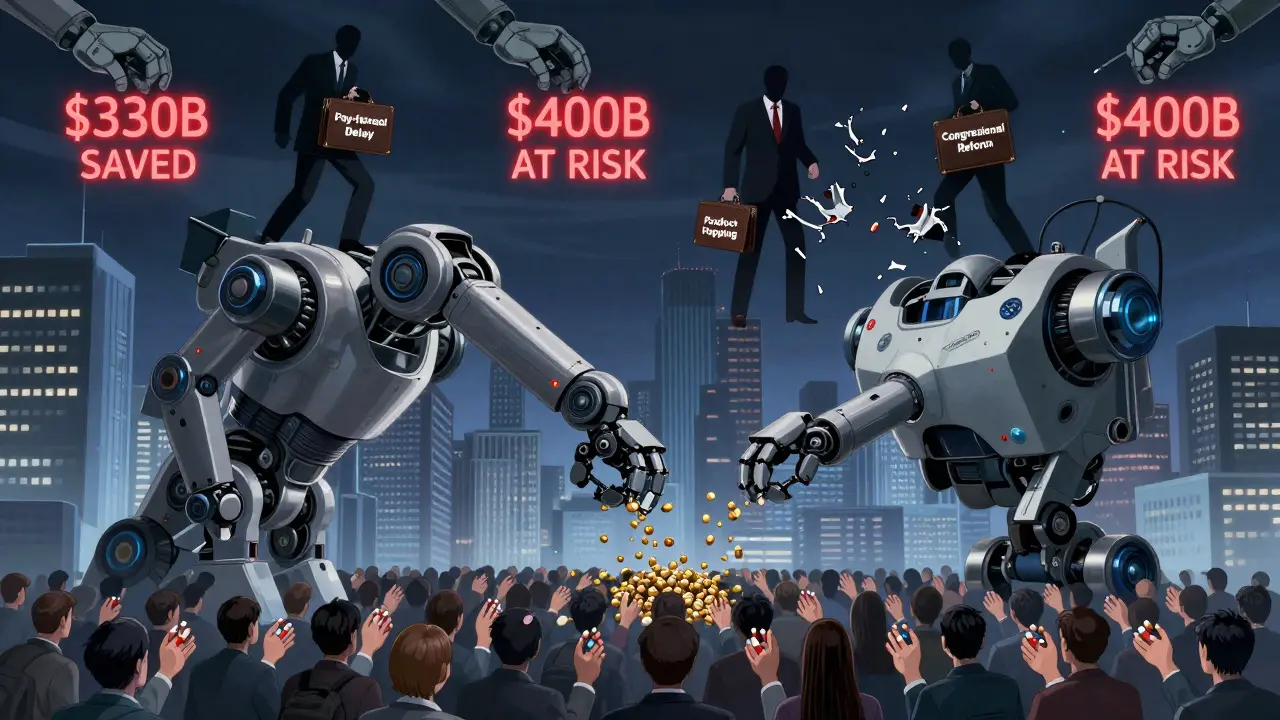
The Hidden Costs: Who Really Pays?
It sounds simple: generics = lower prices. But the system isn’t that straightforward. Pharmacy benefit managers (PBMs)-the middlemen between insurers, pharmacies, and drug makers-control reimbursement rates. And they’re not always transparent. A 2022 analysis from the Schaeffer Center at USC found patients often pay 13-20% more than they should for generics because of how PBMs structure rebates and fees. Pharmacies sometimes lose money on generic prescriptions because the reimbursement rate from PBMs is lower than what they paid to buy the drug. That’s why you’ll hear pharmacists on Reddit complaining they’re losing money on every generic script they fill. Meanwhile, brand manufacturers keep raising prices on their remaining protected drugs. In January 2025, the median price increase for 250 branded drugs was 4.5%-nearly double inflation. That’s not a coincidence. As generics eat away at revenue, brand companies double down on the few drugs still under patent.Adapting or Dying: The New Business Models
Some brand manufacturers have learned to adapt. Instead of fighting generics, they join them. “Authorized generics” are one strategy. The brand company itself launches a generic version of its own drug under a different label. It’s a way to capture a slice of the generic market before competitors do. It’s not ideal, but it’s better than losing everything. Others are shifting focus. Novartis spun off its generics division, Sandoz, into a separate company in 2022. That let the parent company focus on high-margin innovation while Sandoz handled the low-margin, high-volume generic business. It’s a clean separation. Two different business models. Two different profit engines. Some companies are moving into complex generics-injectables, inhalers, and biologics-that are harder and more expensive to copy. These take longer to develop, so competition is slower. But they’re also more profitable than simple pills.
The Bigger Picture: Savings vs. Systemic Waste
Generics save the U.S. healthcare system an estimated $330 billion every year. That’s money that goes back into care, insurance, and patient access. But that money doesn’t always reach patients. It gets lost in the system. PBMs pocket rebates. Wholesalers mark up prices. Insurers pass costs to patients through high deductibles. Meanwhile, generic manufacturers face pressure to cut costs so low that supply shortages become common. The FDA has warned that when prices drop too far, some companies stop making drugs altogether because it’s no longer profitable. The result? A paradox. We have more affordable drugs than ever-but patients still struggle to pay for them. The system is designed to save money, but the middlemen often take the savings.What’s Next? The $400 Billion Challenge
By 2028, an estimated $400 billion in brand drug revenue will be at risk from patent expirations, according to Evaluate Pharma. That’s more than the entire annual budget of the U.S. Department of Education. The FDA’s Generic Drug User Fee Amendments (GDUFA), renewed in 2022 with $1.1 billion in industry fees through 2027, aim to speed up generic approvals without sacrificing quality. That’s good news for patients-but bad news for brand manufacturers still clinging to their last protected drugs. Legislators are pushing back. Bipartisan bills are being introduced to ban pay-for-delay deals and limit product hopping. If passed, these could reshape the industry within five years. The bottom line? Generics aren’t going away. They’re growing. And brand manufacturers have two choices: adapt or disappear. The future belongs to those who can balance innovation with affordability-not just protect it.Why are generic drugs so much cheaper than brand-name drugs?
Generic drugs cost 80-85% less because they don’t need to repeat expensive clinical trials. They use the brand’s existing safety and effectiveness data. They also don’t spend money on marketing or patent protection. Once the patent expires, multiple manufacturers can produce the same drug, driving prices down through competition.
What is the patent cliff and why does it matter?
The patent cliff is the sharp drop in revenue a brand-name drug manufacturer faces when its patent expires and generics enter the market. Sales often fall by 80-90% within the first year. This matters because many pharmaceutical companies rely on one or two blockbuster drugs for most of their income. The cliff forces them to pivot-either by developing new drugs, launching authorized generics, or finding other ways to stay profitable.
Do generic drugs work as well as brand-name drugs?
Yes. The FDA requires generics to have the same active ingredients, strength, dosage form, and route of administration as the brand-name drug. They must also meet the same strict standards for quality, purity, and performance. Millions of patients use generics every day with the same results as the brand version. The only differences are usually in inactive ingredients like color or shape, which don’t affect how the drug works.
Why do some pharmacies lose money selling generic drugs?
Pharmacies sometimes lose money on generics because pharmacy benefit managers (PBMs) set reimbursement rates that are lower than what the pharmacy paid to buy the drug. PBMs negotiate rebates and fees behind the scenes, and those savings don’t always flow to the pharmacy. In some cases, the reimbursement rate is so low that the pharmacy loses money on each prescription, especially for high-volume, low-cost generics.
How do pay-for-delay deals hurt patients?
Pay-for-delay deals happen when a brand-name drug company pays a generic manufacturer to delay launching its cheaper version. This keeps prices high longer. The Blue Cross Blue Shield Association estimates these deals cost patients nearly $3 billion a year in higher out-of-pocket costs. Without these deals, generics would enter the market sooner, lowering prices faster and saving patients money.
Is the generic drug market becoming less competitive?
Yes, in some areas. Between 2014 and 2016, nearly 100 mergers and acquisitions happened in the generic manufacturing industry. Fewer companies mean less competition, which can lead to higher prices and supply shortages. The FDA and Congress are watching this trend closely, especially for essential drugs where only one or two manufacturers remain.

Henry Ip
Generics are the unsung heroes of healthcare. I’ve been on them for years and never noticed a difference. The real villain? PBMs. They’re the ones squeezing pharmacies and still charging patients extra. It’s not the generics’ fault it’s broken.
Stephen Tulloch
LMAO brand pharma crying because they can’t charge $2000 for a pill anymore 😂 The patent cliff? More like the ‘I spent my entire life avoiding real work’ cliff. Generics are the people’s medicine. Let ‘em eat cake. 🎂💊
Corey Sawchuk
Been on a generic statin for 5 years. Same results. Cheaper. My pharmacist told me he loses money on every script. That’s the real issue. Not generics. The middlemen. 🤷♂️
vivek kumar
It is scientifically proven that generic drugs are bioequivalent to brand-name drugs. The FDA requires rigorous testing. The cost difference is purely due to absence of marketing and R&D amortization. Any claim otherwise is misinformation.
Nick Cole
My mom’s on a generic for her blood pressure. She saves $150 a month. That’s groceries, heat, rent. These companies are making billions off people’s desperation. It’s not capitalism. It’s exploitation.
Riya Katyal
Oh so now generics are the heroes? Funny how the same people who scream about 'big pharma' are fine when the generic makers are owned by the same conglomerates. Wake up. It's all the same circus.
Nicholas Gabriel
Let me just say this: generics save lives. Every. Single. Day. And the fact that PBMs are getting rich off the back of patients who can’t afford their meds? That’s not just broken-that’s immoral. We need transparency. Now. And not just lip service.
Cheryl Griffith
I work in a rural clinic. We switch everyone to generics. No one complains. No one gets sicker. The only people upset are the ones who profit from the confusion. It’s wild how much money is wasted just to keep people scared of cheap pills.
swarnima singh
they said generics were safe... but what if theyre secretly replacing the active ingredient with something else? like... i dont know... a government tracking chip? theyve been doing it since the 80s. my cousin’s dog got weird after taking generic heart meds. its not coincidence.
Isabella Reid
In India, generics are how people live. My aunt got cancer treatment because of them. Here, we treat medicine like a luxury. We need to stop pretending this is about science. It’s about power. And money. And who gets to breathe.
Jody Fahrenkrug
My pharmacy ran out of the generic for my antidepressant last month. Took 3 weeks to get it back. Meanwhile, the brand version was in stock. Why? Because no one wants to make the cheap stuff. The system’s rigged.
Kasey Summerer
Brand companies paying generics to not show up? 😭 Classic. Like paying your neighbor to not open a lemonade stand next to yours. And then you charge $20 a cup. This isn’t capitalism. It’s a cartoon.
kanchan tiwari
They’re hiding the truth. The FDA is in bed with Big Pharma. You think they really test generics? Nah. They just stamp ‘approved’ and move on. That’s why people are dying from seizures and heart attacks. They’re using fake generics. It’s a cover-up. I know people who know people.
Bobbi-Marie Nova
Okay but imagine if we treated vaccines like we treat generics-everyone gets the cheap version, no drama, no markups. We’d end pandemics faster. Why is medicine the only industry where ‘cheap’ = ‘suspicious’?
Allen Davidson
Here’s the thing: the patent cliff isn’t a crisis. It’s a reset. Companies spent decades treating medicine like a monopoly game. Now they have to innovate again. That’s not bad. That’s evolution. The ones who survive will be the ones who actually help people-not just extract from them.