
When you’re taking a medication, you expect it to help. But what if your existing health conditions make that same drug more dangerous? It’s not just about the pill itself-it’s about your body’s overall state. People with multiple chronic conditions face a hidden risk: their diseases don’t just coexist with medications-they change how those drugs behave in the body. This isn’t theoretical. Comorbidities triple the chance of serious side effects compared to people who are otherwise healthy.
Why Your Other Conditions Make Medications Riskier
Most drug trials are done on healthy volunteers or patients with just one condition. But real life doesn’t work that way. In Australia, nearly 80% of adults over 65 have two or more chronic diseases. And when you have conditions like diabetes, heart failure, kidney disease, or liver cirrhosis, your body handles drugs differently. Take liver disease. The liver breaks down most medications using enzymes called cytochrome P450. If your liver is damaged, those enzymes drop by 30-50%. That means a standard dose of a painkiller or antidepressant stays in your system much longer. Instead of clearing in 8 hours, it might linger for 24. That’s how a safe dose becomes a toxic one. Kidney problems do the same thing. If your kidneys aren’t filtering well, drugs like metformin or certain antibiotics build up. Even a slight drop in glomerular filtration rate (GFR) can turn a routine prescription into a danger zone. One study found that 66% of all suspected drug side effects happened in patients with comorbidities-not in healthy ones.The Symptom Shift: What Side Effects Look Like With Comorbidities
Side effects aren’t the same across everyone. In healthy people, dizziness might be the most common reaction. But in someone with heart disease, diabetes, and arthritis, the pattern changes. Weakness shows up far more often-36% of side effect cases in comorbid patients. Dizziness drops to 12%, and nausea and vomiting become less frequent. Why? Because your body is already under stress. If you have chronic pain and take a sedative, you’re not just feeling sleepy-you might crash into a state of confusion or falls. If you have Parkinson’s and get an antipsychotic for hallucinations, your tremors could get worse, not better. These aren’t random reactions. They’re predictable because your disease has already lowered your body’s tolerance.Polypharmacy: When More Medicines Mean More Danger
Having multiple conditions usually means taking multiple drugs. The average elderly patient with three or more chronic illnesses takes 4-6 medications daily. That’s not unusual-it’s expected. But here’s the problem: each new drug adds interaction risk. In one study of older adults, 47% had at least one dangerous drug-drug interaction. Nearly a third of those were major-meaning they could cause heart attacks, kidney failure, or brain bleeds. Cancer patients are even worse off: 65% of them had multiple drug interactions, and over a third were high-risk. The math is simple: the more conditions you have, the more drugs you take, and the higher your chance of a bad reaction. Patients on five or more medications are over three times more likely to get a harmful drug than those on just one.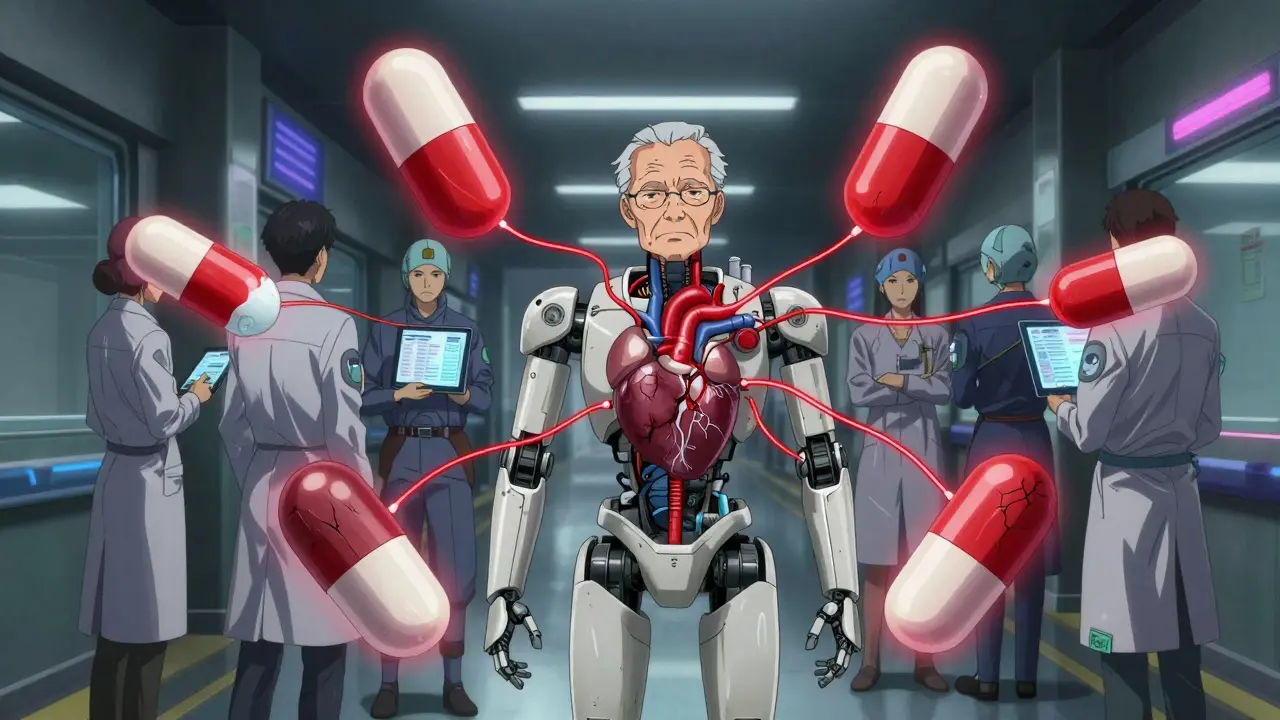
High-Risk Comorbidities and Their Hidden Drug Traps
Some combinations are especially deadly. Take substance use disorders. Up to 93% of people in treatment for alcohol or opioids also smoke. That means they’re taking medications for mental health or pain while their liver is already taxed by nicotine and alcohol. The result? Slower drug clearance, higher overdose risk, and worse outcomes. Chronic pain patients are another high-risk group. About 10% end up misusing their own painkillers. It’s not always addiction-it’s often because the pain keeps returning, and doctors keep prescribing more. That cycle leads to dependence, tolerance, and dangerous interactions with antidepressants or anticonvulsants. Heart disease adds another layer. Many common drugs-like beta-blockers or diuretics-can interact with substances like cocaine, methamphetamine, or even large amounts of caffeine. The heart can’t handle the extra strain. A patient with atrial fibrillation taking a blood thinner might bleed internally if they also use NSAIDs for arthritis.Why Doctors Miss These Risks
You’d think doctors would catch this. But they’re often working with incomplete information. Most clinical trials exclude patients with multiple conditions. That means the data on how a drug works in someone with diabetes, COPD, and depression? It doesn’t exist. About 70-80% of elderly patients with complex health issues were never studied before their drug was approved. Fragmented care makes it worse. A patient might see five different specialists-cardiologist, endocrinologist, neurologist, psychiatrist, pain specialist. Each prescribes their own meds. None of them talk to each other. One prescribes a blood thinner. Another prescribes an NSAID. The result? A stomach bleed that could have been prevented. And time? Doctors rarely have enough of it. Over 70% say they don’t have enough time to review all a patient’s medications properly. That’s why so many patients end up on potentially inappropriate medications-drugs that are known to be risky for older adults or those with certain conditions.
What Works: How to Reduce the Risk
There are solutions-and they’re already working in some places. The most effective is a full medication review by a clinical pharmacist. In one study, these reviews cut side effects by 22%. They look at every pill, every supplement, every over-the-counter drug-and ask: does this still make sense? Can we stop one? Can we switch to something safer? Electronic health records with built-in alerts help too. Systems like Epic and Cerner now flag dangerous combinations when a doctor tries to prescribe. For example, if you have kidney disease and your doctor tries to order a contrast dye for a scan, the system warns them. That’s saved lives. Tools like STOPP/START criteria help doctors know what to stop and what to start. STOPP tells them which drugs to avoid in older adults. START tells them which essential drugs might be missing. When used together, they reduce hospital admissions from drug side effects by 17%.The Future: Personalized Drug Safety
The next big leap is personalization. The NIH just launched a database called the Comorbidity-Drug Interaction Knowledgebase, built from 12 million patient records. It’s already found 217 new dangerous combinations that weren’t on any list before. Machine learning is predicting side effects with 89% accuracy-far better than old methods. And new tools are adjusting drug doses in real time based on lab results, weight, age, and kidney function. Early trials show a 31% drop in side effects when these tools are used. Soon, we’ll see genetic testing combined with comorbidity data to predict exactly how you’ll respond to a drug. Phase II trials are already showing 40% fewer side effects when treatment is tailored this way.What You Can Do Right Now
If you or a loved one has multiple health conditions:- Keep a written list of every medication, supplement, and herbal product you take-including doses and why you take them.
- Ask your doctor or pharmacist: “Could any of these interact with my other conditions?”
- Request a medication review at least once a year-or whenever a new drug is added.
- Don’t assume a new prescription is safe just because it was prescribed by a specialist.
- If you feel unusually tired, dizzy, confused, or nauseous after starting a new drug, tell your doctor immediately. Don’t wait.
Medications aren’t one-size-fits-all. Your health history changes how your body responds. Ignoring that isn’t just risky-it’s dangerous. The good news? We’re getting better at seeing it. And now, so are you.

Natasha Sandra
OMG this is SO true 😭 I had my grandma on 7 meds and she kept falling-turns out two of them were making her dizzy as hell. Her cardiologist didn’t even know she was taking that herbal tea from her friend. We almost lost her. 🙏
Erwin Asilom
The data presented here is statistically significant and clinically relevant. The confluence of polypharmacy and comorbid conditions creates a nonlinear risk profile that is inadequately addressed by current clinical guidelines. Pharmacokinetic and pharmacodynamic interactions are underreported in real-world settings due to fragmented care systems.
Sumler Luu
I appreciate how thorough this is. My dad’s been on five meds since his stroke, and no one ever sat down with all his prescriptions together. I finally got him a pharmacist consult last year-life changed. Just wish more families knew this was an option.
Brittany Fuhs
Of course this is happening. America’s healthcare system is a joke. We let unqualified doctors prescribe like they’re ordering coffee. Meanwhile, in Germany, they have mandatory drug reviews for seniors. We’re falling behind because we don’t care enough.
Sophia Daniels
Let me tell you something-this isn’t just ‘risk,’ it’s a slow-motion massacre. Doctors are playing Russian roulette with people’s lives and calling it ‘standard care.’ I’ve seen elderly patients turn into walking zombies because someone didn’t check if their blood thinner played nice with their new antidepressant. It’s not negligence-it’s negligence with a paycheck.
And don’t get me started on those ‘specialists’ who think their little domain is the whole damn body. Cardiologist writes a script. Neurologist writes another. Pain doc throws in a opioid. Endocrinologist adds insulin. And then the patient ends up in the ER with a GI bleed because no one bothered to ask: ‘Hey, what else are you taking?’
We need to stop treating diseases like separate Lego blocks and start treating PEOPLE. Your kidneys don’t care that your heart has its own specialist. Your liver doesn’t give a damn which department you belong to.
This isn’t a medical problem. It’s a systemic failure dressed in white coats.
And yes, I’m angry. You should be too.
Peter sullen
While the empirical evidence supporting the correlation between polypharmacy and adverse drug events is robust, it is imperative to acknowledge the methodological limitations inherent in retrospective observational studies. The absence of randomized controlled trials involving multimorbid populations introduces potential selection bias and confounding variables that may attenuate the generalizability of the findings.
Furthermore, the implementation of STOPP/START criteria demonstrates promising outcomes; however, scalability remains constrained by resource allocation, clinician training, and interoperability challenges within electronic health record ecosystems.
Future directions must prioritize prospective cohort studies with granular pharmacogenomic stratification to enhance predictive validity.
Steven Destiny
This is the most important thing I’ve read all year. Stop pretending meds are harmless. If you’re on more than three pills, you’re already gambling with your life. And if your doctor doesn’t talk to your other doctors? FIRE THEM. No excuses. Your life is worth more than their laziness.
Amy Lesleighter (Wales)
My mom’s on 4 meds. One was making her forget her own name. We stopped it. She’s been better since. Just because a doc wrote it doesn’t mean it’s right. Listen to your body. And if you’re confused? That’s not aging. That’s a red flag.
Becky Baker
Ugh I hate when people say ‘just take your meds.’ What if your meds are killing you? We need to stop treating seniors like lab rats and start treating them like humans. This isn’t ‘medical progress.’ It’s corporate greed with a stethoscope.
Rajni Jain
I’m from India and we don’t have great healthcare but I’ve seen this too. My uncle took 6 pills for diabetes, high bp, and pain. He got really weak. Then a local pharmacist asked him to stop one-just one-and he felt like a new man. No fancy tech. Just someone who listened.
sakshi nagpal
This is a critical conversation that transcends borders. In developing nations, the absence of electronic health records and specialist coordination exacerbates the risk of iatrogenic harm. Yet, community pharmacists-often underutilized-are uniquely positioned to serve as medication safety gatekeepers. A structured, low-cost intervention model could yield profound public health dividends.
Sandeep Jain
my bro got put on a new heart med and started blacking out. we went to the doc and he said ‘it’s just aging’ but i knew something was off. we got his meds reviewed and they took away one thing-he stopped falling. simple. why is this so hard?
roger dalomba
Wow. A 10-page essay on ‘don’t take too many pills.’ Groundbreaking. Next up: ‘Water is wet.’
Nikki Brown
Of course people are dying from meds-they’re all just lazy and don’t follow instructions. If you can’t handle a simple pill schedule, maybe you shouldn’t be allowed to live alone. This isn’t a systemic failure. It’s personal failure. 🙄