
When you walk into a doctor’s office, hospital, or pharmacy, the first thing they ask is: "Do you have any drug allergies?" It sounds simple. But if you just say "I’m allergic to penicillin" without details, you might be putting your life at risk. That’s because vague answers don’t help doctors-they need the full picture. Documenting drug allergies in your medical records isn’t just a formality. It’s a life-saving step that stops dangerous mistakes before they happen.
Why Your Allergy Info Must Be Exact
Many people think saying "I’m allergic to sulfa" or "I react to ibuprofen" is enough. But that’s not true. Drug allergies aren’t one-size-fits-all. A reaction to sulfamethoxazole (an antibiotic) doesn’t mean you’re allergic to all sulfa drugs. And if you had a rash after taking Advil, that doesn’t automatically mean you can’t take any NSAID. Without specifics, doctors might avoid a safe drug-or worse, give you something dangerous. The U.S. Centers for Medicare & Medicaid Services (CMS) requires that every patient’s medical record clearly lists:- The exact generic drug name (not brand names like "Advil" or "Zithromax")
- The reaction symptoms (rash, swelling, trouble breathing, vomiting, etc.)
- The severity (mild, moderate, life-threatening)
- The timing (when the reaction happened-minutes after taking it? Days later?)
What Counts as a True Allergy?
Not every bad reaction is an allergy. Many people say they’re "allergic" to a drug when they actually had a side effect or intolerance. For example:- Stomach upset from antibiotics? That’s an intolerance-not an allergy.
- A headache after taking aspirin? That’s a side effect.
- A rash after taking penicillin? That could be an allergy.
How to Get Your Allergies Right in Your Records
Don’t wait for your next appointment to fix this. Here’s how to make sure your medical records are accurate:- Review your current records. Request a copy of your medical history from your doctor or hospital. Look at the allergy section. Does it say "penicillin allergy"? Or does it say "rash after taking amoxicillin in 2019, resolved in 3 days"?
- Write down every reaction. Use a notebook. List each drug, the exact name (generic), what happened, how bad it was, and when. Include over-the-counter drugs, supplements, and vaccines.
- Bring it to your next visit. Don’t rely on memory. Hand your list to your provider. Say: "I want to make sure this is documented correctly."
- Ask for clarification. If your doctor writes "allergic to NSAIDs," ask: "Which one? Ibuprofen? Naproxen? Both?"
- Confirm the update. After your visit, ask for a copy of the updated record. Make sure the changes stuck.
What Your Doctor Should Do
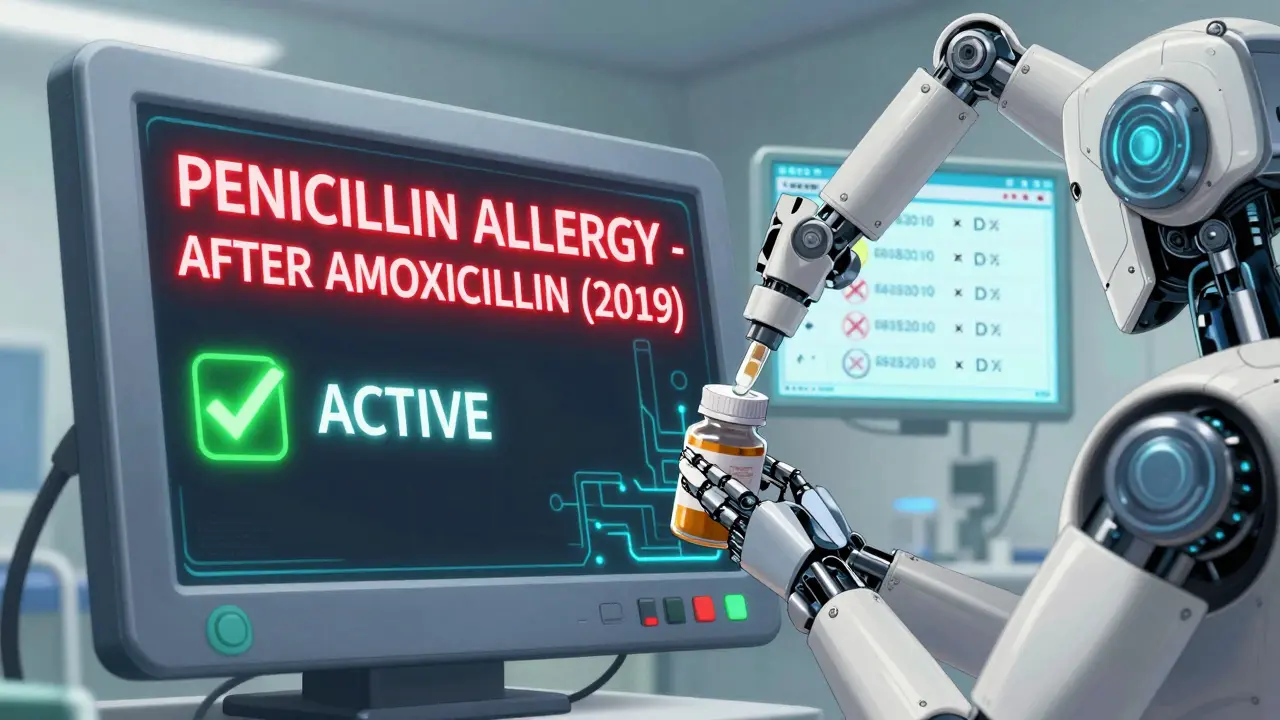
Doctors and nurses aren’t perfect. They’re busy. But they have tools to help. Most electronic health records (EHRs) now have built-in prompts that force providers to:- Enter the drug name in a specific field
- Select symptoms from a dropdown menu
- Choose reaction severity (mild, moderate, severe)
- Mark whether the allergy is still active
What to Do If You Have No Allergies
Even if you’ve never had a bad reaction, your record must say so. "No known drug allergies" (NKDA) isn’t optional. It’s required. Why? Because if your record is empty, doctors assume you’re hiding something. They might avoid prescribing a drug just to be safe. Or worse-they might assume you’re allergic to something you’re not. Always confirm: "I have no known drug allergies." Say it clearly. Ask them to write it down. Then double-check the next time you’re seen.
What’s Changing in 2025 and Beyond
The rules are getting stricter-and smarter. By the end of 2023, all certified EHRs in the U.S. had to use the FHIR standard, which lets your allergy info move safely between hospitals, pharmacies, and clinics. If you switch doctors, your allergy record goes with you. In 2025, the Office of the National Coordinator for Health IT plans to roll out patient-facing tools. That means you’ll be able to update your own allergy list through your hospital’s online portal. No more waiting for an appointment. And soon, AI might help too. Early tests show AI can scan doctor’s notes and pull out allergy details with 85% accuracy. But AI can’t replace you. Only you know what really happened to your body.Final Checklist: Is Your Allergy Info Safe?
Use this quick guide to check your records:- ✅ Are drug names listed in generic form (e.g., "ibuprofen," not "Advil")?
- ✅ Are symptoms described clearly? (Rash? Swelling? Trouble breathing?)
- ✅ Is severity noted? (Mild, moderate, life-threatening?)
- ✅ Is the date of the reaction included?
- ✅ Is there a clear "No Known Drug Allergies" entry if applicable?
- ✅ Does the record say whether the allergy is still active?
What’s the difference between a drug allergy and a side effect?
A drug allergy is an immune system reaction-your body sees the drug as a threat and triggers symptoms like hives, swelling, or anaphylaxis. Side effects are predictable, non-immune reactions, like nausea, dizziness, or headaches. Side effects are common and usually not dangerous. Allergies are rare but can be life-threatening. Only a doctor can tell the difference.
Can I outgrow a drug allergy?
Yes, especially with penicillin. Studies show that up to 95% of people who had a penicillin allergy as a child lose it over time. But unless you get tested, you’ll never know. If you were told you were allergic years ago, ask your doctor about a skin test. It’s quick, safe, and can open up better treatment options.
Should I carry a medical alert card for drug allergies?
It’s a good idea-but not a replacement for accurate records. A card can help in emergencies, but it doesn’t update with new information. Your electronic medical record is your main safety tool. Make sure it’s correct first. Then, if you want extra protection, carry a card with your confirmed allergies and emergency contact.
What if I don’t remember the exact drug name?
Write down everything you remember: the color of the pill, the reason you took it, how long ago, and what happened. Bring old prescriptions or bottles to your appointment. Even partial details help. Doctors can match them to known drugs. Don’t say "I think it was an antibiotic"-say "I got a rash after taking a white pill for a throat infection in 2018." That’s enough to start the investigation.
Can my pharmacist see my allergy history?
Yes-if your records are in a system that shares data with pharmacies. Most EHRs now connect to pharmacy networks using the FHIR standard. When you fill a prescription, the pharmacist sees your active allergies. That’s why it’s critical to keep your records updated. If your allergy isn’t in the system, the pharmacist won’t know-and they can’t warn you.

Kal Lambert
Just got back from my doc visit and they updated my allergy record. Used to say 'penicillin allergy' - now it says 'mild rash after amoxicillin in 2017, resolved in 4 days, no anaphylaxis'. Made all the difference. Took 5 minutes. Do it.
Melissa Stansbury
I had no idea so many people think 'allergy' means any side effect. My mom said she was allergic to ibuprofen because it gave her a headache. She's been avoiding it for 15 years. We finally got her tested - turns out she's fine. Now she takes it for her arthritis. Life changed.
Shameer Ahammad
It is imperative, nay, non-negotiable, that patients meticulously document every single adverse reaction - not merely 'drug allergies' - because the healthcare system is riddled with negligence, and unless you, the individual, take absolute responsibility for your own medical data, you are at grave risk. I have personally witnessed three cases where vague entries led to lethal misprescriptions. This is not hyperbole. It is fact.
Alexander Pitt
The 90-95% penicillin misdiagnosis stat is wild. I had a rash at 12, got labeled allergic, avoided it for 20 years. Got tested last year. Negative. Now I’m on amoxicillin for a sinus infection - and it worked better than any other antibiotic I’ve tried. Don’t assume. Get tested.
Manish Singh
In India, we don’t even have proper EHRs in most clinics. I had to print out my own allergy list, scan it, and email it to every new doctor. They still write 'penicillin allergy' without asking details. So I carry a laminated card. But honestly? The real issue is lack of training. Nurses don’t know how to input this stuff. It’s not the patient’s fault - it’s the system.
Nilesh Khedekar
they dont want you to know this but the gov and big pharma are secretly pushing this 'exact allergy' thing so they can sell you more expensive drugs. if you're 'allergic' to penicillin, they give you vancomycin or linezolid - way more profit. they dont care if you're really allergic. they just want you to pay more. i got my records changed to 'no allergy' and saved $1200 on one prescription. they hate when you catch on.
Robin Hall
The implementation of FHIR standards for allergy data exchange is a necessary but insufficient step. The underlying issue remains: the medical establishment continues to rely on patient-reported data without sufficient verification protocols. This creates a systemic vulnerability. One inaccurate entry - even one - can cascade into lethal consequences. We must mandate third-party validation of all allergy claims via clinical testing before they are logged into any EHR.
Suchi G.
I just want to say... I’ve been through so much. My daughter had a reaction to amoxicillin when she was 2. It was scary. We thought it was an allergy. We were told to avoid all penicillins forever. But then she got pneumonia at 14 and the doctor said she had to take it. We were terrified. We did the skin test. She was fine. I cried. I cried because we spent 12 years avoiding a safe drug. I cried because no one ever explained the difference between allergy and side effect. I cried because I didn’t know. I didn’t know. And now I’m screaming it from the rooftops: if you think you’re allergic - get tested. Please. For your kids. For yourself. Don’t let fear decide your health. It’s not just about penicillin. It’s about trust. And we’ve been lied to. And I’m so tired.